What advantages do CFD and FEM simulations offer in the design of industrial mizers?

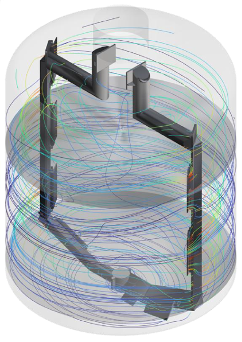
In modern industrial design, technical simulation has become an indispensable tool because it allows the actual behaviour of an mixing equipment to be predicted long before the manufacturing stage begins. Traditionally, the industry has relied on generic estimates, but thanks to Computational Fluid Dynamics (CFD), it is possible to accurately visualise the flow of the product inside the tank, while Finite Element Analysis (FEM) guarantees the structural integrity of the equipment.


This methodology provides unmatched accuracy by eliminating the margin of error that often results from the use of generic power curves found in technical literature. In addition, it gives engineers great versatility, allowing them to design equipment that is capable of processing products with different densities and viscosities, adapting perfectly to both Newtonian and non-Newtonian fluids.

What are the main anchor mixer designs and which one should you choose?

Selecting the right geometry is critical to the success of the process. To facilitate this analysis, three key geometric configurations that meet different industrial needs have been compared:

  1. Flat plate anchor with rear reinforcements: This is the robust reference design, which has been specifically designed to provide maximum structural rigidity for the most demanding applications.
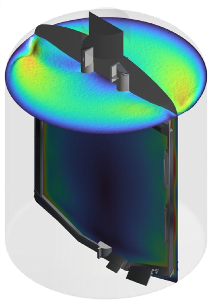
  2. Bent flat plate anchor: This configuration represents an optimised evolution in mixing engineering, as it significantly reduces weight while maintaining hydraulic efficiency.
  3. Tube anchor without reinforcements: This is an alternative hydrodynamic design aimed at applications with specific requirements for higher agitation speeds.


How can fluid dynamic performance be improved and dead zones in the tank be avoided?

The detailed design of the anchor geometry is a critical factor in controlling product movement and achieving total process control.

In terms of tank wall efficiency, all our designs ensure continuous renewal of the fluid in contact with the surfaces through the use of scrapers, which is essential to prevent the formation of thermal dead zones that could compromise product quality.

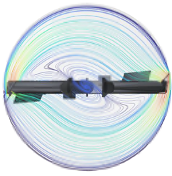
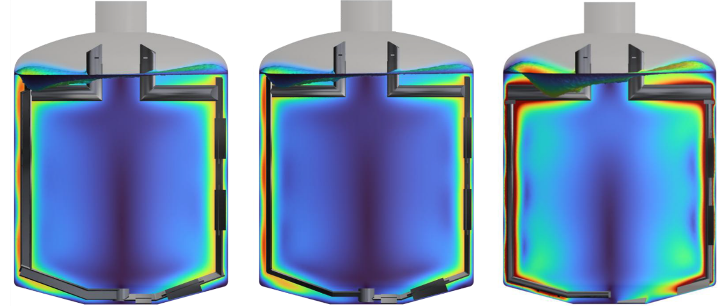
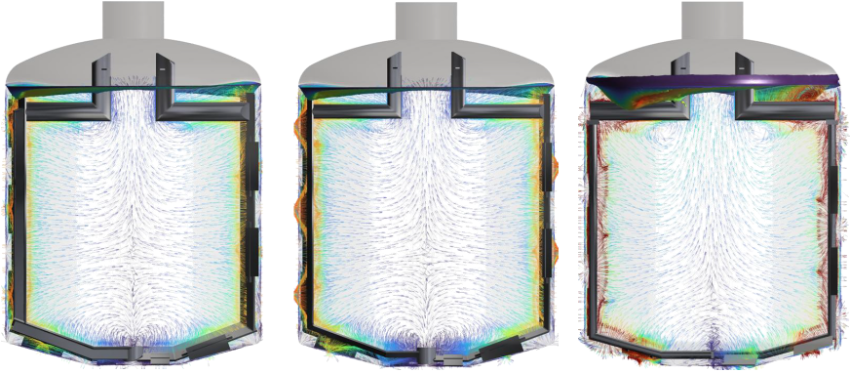
With respect to rotational flow, CFD simulations clearly show that the maximum fluid velocity is concentrated at the tank periphery. If the production process requires a strong axial flow in the central region, additional mixing elements must be incorporated in that area.


Furthermore, hydrodynamic performance also allows optimisation of operating speed; for example, simulations show that while flat-plate designs operate effectively at just 12 rpm, the tube anchor design without reinforcements requires speeds of up to 25 rpm to achieve equivalent mixing performance.

How to calculate motor power for non-Newtonian and high-viscosity fluids?

One of the key advantages of advanced simulations is the ability to process complex products with a high level of reliability. In industry, a common mistake is to treat a complex fluid as Newtonian, which can often lead to unnecessary oversizing of the mixer motor.

To address this issue, CFD simulation analyses the actual shear rate of the product in motion, allowing us to calculate the so-called ‘effective viscosity’. Accurate determination of this value allows the required installed power to be safely reduced compared to the oversizing typically resulting from traditional analytical calculations.

All of this applies across a wide operating range , with flow behaviour analysed from very low viscosities up to extreme demands of 2000 Poise. As a result, the final equipment configuration is accurately tailored to the specific density and consistency of your product.


How to ensure structural strength and optimise the weight of the mixer?

An industrial mixer must not only provide effective mixing performance but also ensure durability and safety throughout its service life. FEM (Finite Element Analysis) simulation ensures mechanical integrity while enabling cost optimisation.

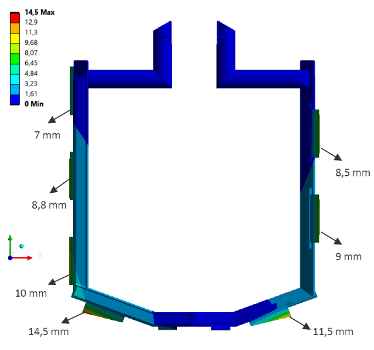
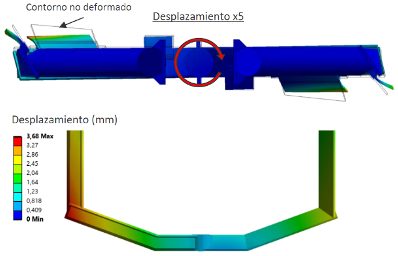
For example, in terms of Factor of Safety, the flat-plate anchor design with rear reinforcements provides a very conservative margin of FoS = 2.2, making it suitable for withstanding extreme loads without risk of failure.


On the other hand, if we are looking for material efficiency, stress analysis allows us to accurately identify critical load points so that reinforcements can be applied only where strictly necessary, thus preventing structural failure due to plastic deformation under high viscosity conditions.


The result of this analysis is the development of a bent flat-plate anchor design, which achieves an impressive 41% reduction in the equipment weight , while maintaining similar hydrodynamic performance and significantly reducing material costs.

Why choose Oliver + Batlle’s customised mixers for your industrial process?

Thanks to the comprehensive implementation of advanced simulation, choosing Oliver + Batlle technology offers direct competitive advantages for your production plant.

• Energy savings: Precisely dimensioned motors optimised for non-Newtonian fluids, avoiding unnecessary energy consumption.

• Efficient design: Optimisation of geometry and construction materials to improve overall equipment efficiency and significant reduction in your equipment’s carbon footprint.

• Custom design: Each mixer is configured according to the specific viscosity and density range of your process, avoiding generic solutions that may compromise efficiency and productivity.

Do you need advice on how to optimise your agitation process?

Each industrial process has specific requirements in terms of viscosity, density, temperature and consistency. Our technical team can evaluate your application and recommend the most suitable geometry, power and configuration, ensuring optimised energy efficiency and structural reliability.

Contact us for a tailored technical study and to optimise your plant’s performance with confidence.

You can also find all the information about our range of Oliver + Batlle industrial mixers, where you will find tailor-made solutions for every production need.


From March 24 to 26, Oliver+Batlle will be present at Eurocoat 2026, the leading event in France for professionals in the paint, ink, varnish, adhesive, and coating industries. The fair, held in Paris, brings together manufacturers, formulators, and suppliers of raw materials and technology, establishing itself as one of the main meeting points for the sector in Europe.

Oliver + Batlle consolidates its commitment to innovation and customer proximity. At this edition of Eurocoat, the company will have a stand (Stand B27), where it will present its solutions for optimizing manufacturing processes, with a special focus on the French market and neighboring European countries.

Technology geared towards industrial performance

During the three days of the fair, visitors will learn about our latest innovations in industrial equipment and process systems, designed to bring efficiency, versatility, and precision to production. Oliver+Batlle‘s solutions combine the mechanical robustness that characterizes us with advanced control technologies, allowing them to be optimally adjusted to the specific requirements of each manufacturer.

Various innovations will be on display at our stand. We will present our Dispermix Dual, a twin-shaft mixer-disperser with variable speed designed to work with medium and high viscosity products. Thanks to the combination of butterfly agitation and a dispersing disc, the equipment improves the homogeneity of the mixture, reduces processing times, optimizes energy consumption, and adapts to different formulations and production requirements.

With this technological approach, Oliver+Batlle responds to the current demands of the sector, promoting more efficient, controlled, and adaptable processes, aligned with the challenges of competitiveness and sustainability in the industry.

A key meeting point for the industry

Eurocoat has established itself as a leading technical and commercial platform where trends, innovations, and technological solutions for the manufacture of paints and coatings are shared. Participating in Eurocoat reinforces our strategy of proximity to the French and European markets. For Oliver+Batlle, this event is an opportunity to present our technological developments, listen to the real needs of the market, strengthen relationships with customers and partners, and drive innovation applied to industrial processes.

We look forward to seeing you at Eurocoat 2026

We invite all professionals in the sector to visit our stand and discover how we transform technology into real performance for our production processes.

Our team (Xavier Villanueva, Area Manager France, and Eduardo Serna, Area Manager Europe) will be at your disposal to talk and share experiences about the challenges and opportunities facing the sector.

In the paints and coatings industry, efficiency is not just a goal; it is a competitive necessity. However, many production lines are still held back by conventional dosing technologies that create bottlenecks, product waste, and high maintenance costs.

At Oliver + Batlle we have launched a 3D additive manufacturing nozzle service that does not just sell a product, but optimises your entire packaging process.

Why switch from traditional metal nozzles to 3D technology?

Additive manufacturing allows us to design “layer by layer”, breaking the limitations of traditional machining and offering tangible benefits in three critical areas:

1. Increased productivity and profitability

  • Manufacturing speed: Our nozzles allow for up to a 20% increase in filling speed compared to conventional dosers.
  • Time optimisation: Reducing the seconds per dosing cycle is the most direct way to increase your daily output.
  • Cost reduction: Improved efficiency, together with annual contract options including 10% discounts, significantly reduces the total cost of ownership.


2. Packaging quality: Zero drips, zero foam

One of the biggest challenges in paint packaging is difficult products that generate foam or residual dripping.

  • Precision design: Each nozzle is custom-designed for the specific rheology of your product.
  • A diameter for every container: We apply the principle of an optimal nozzle according to the container diameter, ensuring a millimetre-perfect fit and an impeccable finish.


3. Technical superiority of the material

Unlike heavy metal parts, our 3D nozzles offer:

  • Minimum weight: Reduces mechanical stress and wear on the dosing arms of your machines.
  • Greater impact resistance: Manufactured with high-durability technical polymers that withstand the pace of an industrial plant.
  • Ad-hoc flexibility: The process begins with a preliminary study and the development of a functional prototype to ensure the solution is perfect before final production.


A service model designed for your business

We understand that production varies, which is why our model is fully flexible. We offer a service with no long-term commitment which includes:

  • Personalised study and design.
  • Scheduled deliveries to guarantee your stock.
  • Express service: Deliveries within 24 hours in Europe and 72 hours in the rest of the world for urgent situations.


Conclusion

The digitalisation of dosing is here to stay. With Oliver + Batlle’s 3D nozzles, your company not only gains speed, but also a packaging quality that your customers will notice from the very first tin.

Are you ready to transform your production line? To discover the potential savings and see our rates (with nozzles starting from €180), contact our sales team today.

Challenge: Increase production capacity without expanding facilities, working with variable batches of varnishes and water-based and solvent-based paints.

Solution: Polimix DPS-5000-TRC ATEX disperser.

Result: Significant increase in production capacity, greater operational flexibility, and reduction in manual operator intervention.


1. IRURENA GROUP

IRURENA Group is a family-owned industrial company founded in 1969, specialized in the manufacture of varnishes and paints for industrial applications, mainly on wood, in both water-based and solvent-based formulations.

2. Products and Manufacturing Challenges

  • Water-based paints for industrial applications on wood
  • Solvent-based paints with ATEX requirementsTechnical complexity: The variability of formulations and production volumes required a dispersion system capable of adapting to different products while maintaining process quality and production efficiency.
  • Industrial varnishes for high-quality professional finishes on wood

Technical complexity: The variability of formulations and production volumes required a dispersion system capable of adapting to different products while maintaining process quality and production efficiency.

3. Project Objectives

Main objective: Increase the production capacity of the existing plant by incorporating new dispersion equipment capable of working with both small and large batches, without the need to expand facilities or modify the manufacturing platform.

Challenge Description
Space Integration of equipment in a reduced space, within an already operational production facility.
Coordination Technical coordination with different project contractors, ensuring proper integration with auxiliary systems for liquid and solid feeding, dust and vapor extraction, cleaning solvents, complying with ATEX requirements.
Installation Execution of complex maneuvers, conditioned by equipment dimensions and plant access limitations.

Critical requirement: The entire project had to guarantee safe, reliable operation oriented toward optimizing daily operations.

4. Implemented Solution


Polimix DPS-5000-TRC ATEX Equipment

Oliver + Batlle designed and manufactured a high-power disperser specifically configured for the client’s production needs, ensuring maximum efficiency and operational safety.

Main Technical Features

  •   Truncated-conical design: Allows efficient work with both small and large product volumes
  •   Disperser shaft raising and lowering system: Provides flexibility and control during the manufacturing process
  •   Half-pipe cooling jacket: Ensures thermal stability of the product during dispersion
  •   Automatic cleaning system: Using mobile lances, with integrated process control
  •   Complete control of the equipment: HMI touchscreen in classified zone, while  PLC and electrical cabinet are located in safe area, fully compliant with ATEX requirements.

The equipment was installed on a carbon steel support structure with primer coating, designed at the same height as the existing production platform. Oliver + Batlle provided the loads transmitted to the floor so that the client could execute the corresponding foundations, as well as the anchor plates on which the structure and the equipment rest. The position of the liquid and powder loading connections and the vapour/dust extraction points was also defined.

A specialized technician from Oliver + Batlle coordinated the positioning operations, final assembly, and commissioning of the equipment, ensuring its proper integration into the plant.

Process diagram of supplied equipment:

3D views of the equipment on its structure, integrated in the existing factory:

5. Results

  •  Significant increase in the production capacity of the existing plant without the need to expand facilities
  • Maximum operational flexibility: production of large and small batches of a wide variety of products using a single disperser
  • Improved efficiency of the production process through integrated automatic control
  • Reduced operator intervention: manual and automatic operation, and integrated cleaning system

6. Conclusion 

This project demonstrates how a customized engineering solution, properly integrated into an existing installation, optimizes production and prepares the plant for future growth.

The combination of specialized technical design, ATEX regulatory compliance, integration within reduced space, and process automation has enabled IRURENA GROUP to strengthen its competitive position in the industrial coatings market.