
Industrial optimisation through advanced simulation (CFD and FEM)
What advantages do CFD and FEM simulations offer in the design of industrial mizers?
In modern industrial design, technical simulation has become an indispensable tool because it allows the actual behaviour of an mixing equipment to be predicted long before the manufacturing stage begins. Traditionally, the industry has relied on generic estimates, but thanks to Computational Fluid Dynamics (CFD), it is possible to accurately visualise the flow of the product inside the tank, while Finite Element Analysis (FEM) guarantees the structural integrity of the equipment.
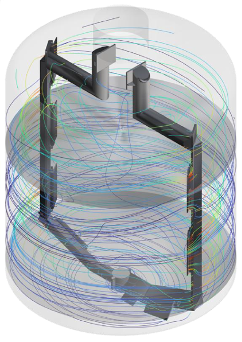
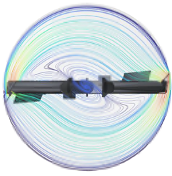
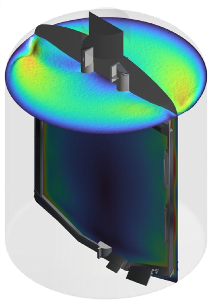
This methodology provides unmatched accuracy by eliminating the margin of error that often results from the use of generic power curves found in technical literature. In addition, it gives engineers great versatility, allowing them to design equipment that is capable of processing products with different densities and viscosities, adapting perfectly to both Newtonian and non-Newtonian fluids.
What are the main anchor mixer designs and which one should you choose?
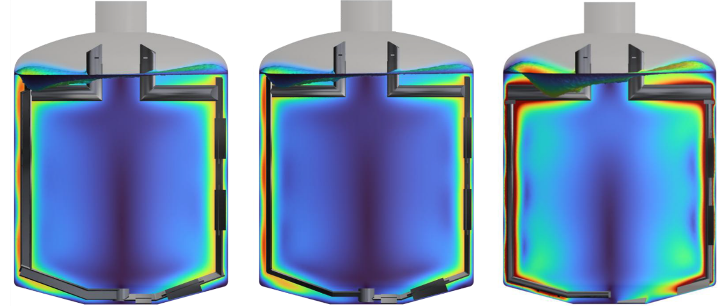
Selecting the right geometry is critical to the success of the process. To facilitate this analysis, three key geometric configurations that meet different industrial needs have been compared:
- Flat plate anchor with rear reinforcements: This is the robust reference design, which has been specifically designed to provide maximum structural rigidity for the most demanding applications.
- Bent flat plate anchor: This configuration represents an optimised evolution in mixing engineering, as it significantly reduces weight while maintaining hydraulic efficiency.
- Tube anchor without reinforcements: This is an alternative hydrodynamic design aimed at applications with specific requirements for higher agitation speeds.

How can fluid dynamic performance be improved and dead zones in the tank be avoided?
The detailed design of the anchor geometry is a critical factor in controlling product movement and achieving total process control.
In terms of tank wall efficiency, all our designs ensure continuous renewal of the fluid in contact with the surfaces through the use of scrapers, which is essential to prevent the formation of thermal dead zones that could compromise product quality.
With respect to rotational flow, CFD simulations clearly show that the maximum fluid velocity is concentrated at the tank periphery. If the production process requires a strong axial flow in the central region, additional mixing elements must be incorporated in that area.
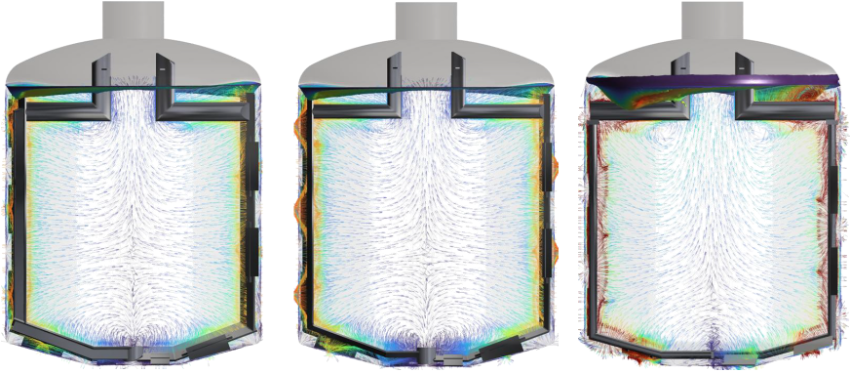
Furthermore, hydrodynamic performance also allows optimisation of operating speed; for example, simulations show that while flat-plate designs operate effectively at just 12 rpm, the tube anchor design without reinforcements requires speeds of up to 25 rpm to achieve equivalent mixing performance.
How to calculate motor power for non-Newtonian and high-viscosity fluids?
One of the key advantages of advanced simulations is the ability to process complex products with a high level of reliability. In industry, a common mistake is to treat a complex fluid as Newtonian, which can often lead to unnecessary oversizing of the mixer motor.
To address this issue, CFD simulation analyses the actual shear rate of the product in motion, allowing us to calculate the so-called ‘effective viscosity’. Accurate determination of this value allows the required installed power to be safely reduced compared to the oversizing typically resulting from traditional analytical calculations.
All of this applies across a wide operating range , with flow behaviour analysed from very low viscosities up to extreme demands of 2000 Poise. As a result, the final equipment configuration is accurately tailored to the specific density and consistency of your product.
How to ensure structural strength and optimise the weight of the mixer?
An industrial mixer must not only provide effective mixing performance but also ensure durability and safety throughout its service life. FEM (Finite Element Analysis) simulation ensures mechanical integrity while enabling cost optimisation.
For example, in terms of Factor of Safety, the flat-plate anchor design with rear reinforcements provides a very conservative margin of FoS = 2.2, making it suitable for withstanding extreme loads without risk of failure.


On the other hand, if we are looking for material efficiency, stress analysis allows us to accurately identify critical load points so that reinforcements can be applied only where strictly necessary, thus preventing structural failure due to plastic deformation under high viscosity conditions.
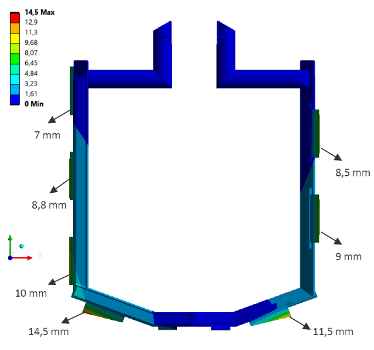
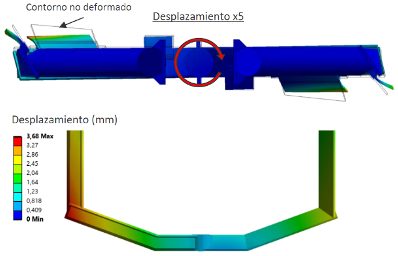
The result of this analysis is the development of a bent flat-plate anchor design, which achieves an impressive 41% reduction in the equipment weight , while maintaining similar hydrodynamic performance and significantly reducing material costs.
Why choose Oliver + Batlle’s customised mixers for your industrial process?
Thanks to the comprehensive implementation of advanced simulation, choosing Oliver + Batlle technology offers direct competitive advantages for your production plant.
• Energy savings: Precisely dimensioned motors optimised for non-Newtonian fluids, avoiding unnecessary energy consumption.
• Efficient design: Optimisation of geometry and construction materials to improve overall equipment efficiency and significant reduction in your equipment’s carbon footprint.
• Custom design: Each mixer is configured according to the specific viscosity and density range of your process, avoiding generic solutions that may compromise efficiency and productivity.
Do you need advice on how to optimise your agitation process?
Each industrial process has specific requirements in terms of viscosity, density, temperature and consistency. Our technical team can evaluate your application and recommend the most suitable geometry, power and configuration, ensuring optimised energy efficiency and structural reliability.
Contact us for a tailored technical study and to optimise your plant’s performance with confidence.
You can also find all the information about our range of Oliver + Batlle industrial mixers, where you will find tailor-made solutions for every production need.