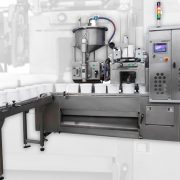
Key Factors in the Manufacturing of Phytosanitary Products as Aqueous Suspensions
The evolution from powder formulations to aqueous suspensions (flows) has represented an important advancement in phytosanitary product manufacturing, offering benefits in safety, dosing, and the distribution of active ingredients.
This evolution responds both to the need to improve occupational safety and environmental protection and to the pursuit of greater efficiency in the application of phytosanitary products.
In this article, we outline the essential stages of the aqueous suspension production process and the key technologies required to optimize each step.
Why Choose Aqueous Suspensions for Phytosanitary Products?
Processing active ingredients in a liquid medium offers major advantages over traditional dry powder handling:
- Enhanced Safety and Cleanliness: Reduces harmful dust emissions and minimizes operator exposure.
- Precise Dosing and Application: Simplifies accurate measuring and allows for easier cleaning of spraying equipment.
- Higher Biological Activity: Promotes a homogeneous distribution and a more consistent particle size of the active ingredient.
Critical Stages in the Phytosanitary Production Process
To ensure a stable suspension that meets CIPAC technical standards, the manufacturing process must be carefully engineered across five main stages:
Dispersion and Raw Material Incorporation
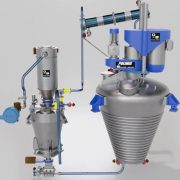
In this initial stage, active ingredients in powder form are incorporated into the liquid medium using industrial dispersing agitators.
Due to the thermal sensitivity of certain active ingredients and the presence of corrosive or chlorinated components, it is important to use jacketed cooled vessels (made of AISI 360L) and enclosed systems is vital to prevent dusting and foaming.
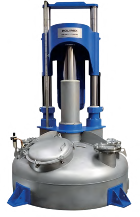
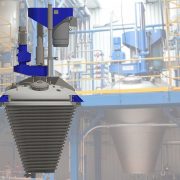
POLIMIX DPS 1 from 2,000 to 5,000 L (o liters)
Milling and Particle Size Reduction
The goal of milling is to ensure that 50% of the particles are smaller than 5 microns and 90% remain below 10 microns. Selecting the right milling technology at this stage is crucial, as it directly impacts both processing times and total plant energy consumption.
Finishing, Storage, and Homogenization
After milling, the product is transferred to finishing tanks equipped with variable speed radial-axial agitators. This allows different batches to be homogenized and additives or thickeners to be incorporated to stabilize the rheology before filling.
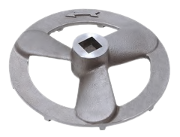
RADIAL-AXIAL AGITATOR TURBINE
Pumping, Filtration, and Final Packaging
To protect final product quality and prevent the presence of coarse particles or grinding media residues, pneumatic pumping and fine filtration systems are used. Finally, the product is filled using gravimetric filling equipment or filling systems adapted to different container formats and production capacities.
If you would like to save this information for your team or review detailed dispersion formulas, you can download the complete PDF guide to keep on hand.
Technology Comparison: Optimizing Energy Consumption in Milling
Energy efficiency in the milling phase is one of the greatest operational challenges in phytosanitary plants. Comparative laboratory tests conducted with active ingredients such as copper oxychloride demonstrate significant efficiency variations depending on the chosen equipment—such as continuous horizontal bead mills (Supermill EHP) versus immersion basket mills (Mill-ennium RS):
One of the biggest challenges in manufacturing plants is the energy cost associated with milling. In laboratory trials conducted at Oliver + Batlle using copper oxychloride, two milling technologies were compared: continuous horizontal bead mill (Supermill EHP) and immersion mill (Mill-ennium RS20), revealing significant differences in energy consumption and processing times:
- Energy Savings: Under the tested conditions, immersion milling reduced energy consumption per liter produced by up to 77% compared with horizontal milling in two passes.
- Time Efficiency: For the same production volume, processing time was reduced by nearly 80%.
Download the Full Phytosanitary Manufacturing Guide
Looking for deeper technical insights into machine parameters, dispersion formulas, grinding media selection, and turnkey plant engineering?
We have compiled a comprehensive technical e-book authored by Joaquín Oliver, Industrial Engineer and industry expert with over 40 years of experience. Inside, you will find:
- Typical formulation components and technical recommendations for dispersion processes.
- Information on different milling technologies and results of laboratory trials conducted by O+B using copper oxychloride.
- Guidelines for basic engineering design and integrated production facilities.
? Download the E-book: Manufacturing Phytosanitary Products in Aqueous Suspensions
Stay updated on our latest news on LinkedIn.