
Optimizing immersion grinding: Key takeaways from the Webinar “Basket Mills: Tailoring Accessories and Configurations for Maximum Performance”
At Oliver + Batlle, our commitment to technical innovation and process excellence in the manufacturing of paints and coatings is constant. We recently hosted a technical webinar titled “Basket Mills: Tailoring Accessories and Configurations for Maximum Performance”, presented by our product and technical experts: Miquel Vidal (Mixing & Grinding Product Manager), Adrià Artigas (Laboratory Manager), and Jens Michael Müller (Area Manager).
If you were unable to attend live or wish to review the core concepts discussed, here is a summary of the main technical takeaways and technological trends covered during the session:
The importance of Mill-ennium RS technology and circulation
Immersion grinding using Mill-ennium RS technology allows dispersion and grinding to take place within a single vessel, eliminating the need for transfer pumps and hoses, reducing product losses, and enabling fast color changes alongside simplified cleaning.
During the first part of the webinar, it was emphasized that grinding efficiency directly depends on product turnover (or recirculation rate) through the basket:
- Performance driven by circulation: Poor circulation creates dead zones, temperature gradients, and slow fineness development.
- Accessory selection as a process variable: Choosing the right impeller, scraper, or auger is not merely a mechanical option, but a direct process variable affecting rheology and overall efficiency.
Tools and accessories: Tailoring the mill based on viscosity
As viscosity or rheological complexity increases within a formulation, precise accessory selection becomes essential to ensure both continuous feeding into the basket and effective thermal control.
Starting with lower circulation impellers, the standard choice in Mill-ennium technology is the Turbo Impeller, designed to provide a balanced combination of shear and pumping action for low-to-medium viscosity coatings, making it the ideal selection for decorative paints or other products with similar characteristics. As viscosity rises and product mobility decreases, the Turbo + Pumper configuration is utilized; this design incorporates additional paddles to substantially increase the pumping effect, improving overall bulk circulation in structured systems. Meanwhile, the Marine Propeller is primarily reserved for simple mixing tasks or extremely fluid, low-viscosity products.
Unlike other accessories, such as orbital scrapers or vacuum lids, which must be incorporated into the equipment during the design stage, it is important to highlight that Mill-ennium RS units are supplied as standard with both the Turbo Impeller and the Pumper. Switching from one to the other is quick and straightforward.
In scenarios where product viscosity or yield stress prevents natural flow into the basket, the Auger feed screw comes into play. This optional accessory is installed at the basket inlet to force material into the grinding chamber, stabilizing product flow and ensuring optimal basket utilization in challenging high-solids formulations.
Finally, temperature control and batch homogeneity are completed by Scraper Systems. The Orbital Scraper continuously cleans the vessel walls to eliminate stagnant material near cooling surfaces, while also breaking vortex formation and minimizing air entrapment. Laboratory testing shows that its use increases the overall heat transfer coefficient by up to 67% and reduces the product temperature rise by 40% relative to cooling water temperature. For the most demanding applications with elevated viscosities, the Helical Scraper combines wall scraping with dynamic axial pumping, moving material from top to bottom to achieve full-vessel turnover.
Laboratory results and engineering selection matrix
Adrià Artigas presented a series of laboratory trials evaluating flow behavior in HEC (Hydroxyethyl cellulose) water-based systems across various viscosity levels:
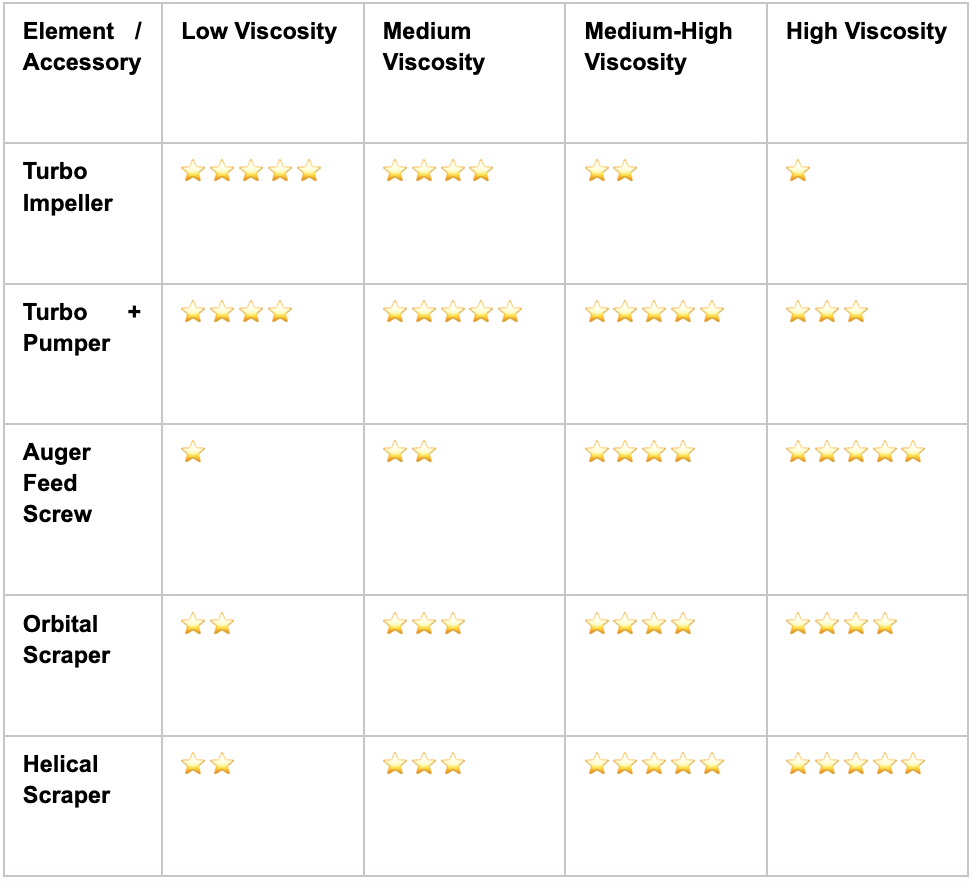
Practical tests demonstrated how, at viscosities up to 18,000 cP, combining a Turbo + Pumper + Orbital Scraper + Auger maintains smooth, continuous recirculation without cavitation or overheating.
In summary
The webinar made it clear that optimizing basket mill performance in the paints and coatings sector no longer depends simply on increasing motor horsepower, but on smart management of product circulation and rheology. By leveraging the right combination of impellers, feed screws, and scraper systems, manufacturers can significantly reduce process times, eliminate dead zones, control temperature, and secure highly profitable, efficient production.
Missed It? Watch the webinar replay!
Aligning your equipment configuration with the rheological behavior of your formulations is the benchmark for remaining competitive. If you would like to explore how these technologies can be applied to your dispersion and grinding processes, watch practical laboratory demonstrations, or hear directly from our technical team, we invite you to view the full session recording.
And if you are considering modernizing your milling processes or implementing a more efficient production engineering approach, contact our technical team today. At Oliver + Batlle, we are ready to guide you toward maximum plant productivity.