Introduction

In the paints and coatings sector, efficiency in manufacturing and packaging processes is key to ensuring competitiveness and maintaining high quality standards. In this context, JOTUN, one of the most renowned paint and coatings manufacturers worldwide, entrusted Oliver + Batlle to carry out a strategic project to automate its high-cadence packaging lines.

Company overview

Jotun is one of the world’s leading manufacturers of paints and coatings, with almost a century of expertise in protecting and beautifying surfaces across all industries. From iconic architectural landmarks to residential projects, Jotun has established itself as a trusted partner thanks to its commitment to quality, innovation, and sustainability.

The company operates across a wide range of market segments:

  • Decorative paints for interior and exterior applications.
  • Architectural and design coatings providing both performance and aesthetics.
  • Infrastructure protection for industrial and large-scale projects.
  • Light industry with advanced powder coatings.
  • Shipping with marine coatings.

  • Energy sector with protective and powder solutions.

Jotun’s continuous investment in research and development reflects its focus on delivering environmentally friendly technologies and high-performance products.

Product to be processed

The project focused on stucco and wall putties for interior use, products that require precise and reliable handling due to their physical properties:

  • Specific gravity: up to 2.2 kg/dm³
  • Viscosity: medium range, up to 6000 cP

These formulations are specifically designed to provide excellent surface preparation, offering a smooth and uniform base layer for subsequent paint or coating applications.

Project objective

The customer’s objective was the supply of two complete high-speed filling lines for stucco and putty products, designed to deliver:

  • Packaging flexibility: from 0.9 L to 20 L (both pails and cans).
  • Universal configuration: each filling line capable of handling the entire range of formats.
  • Integrated discharge and pumping systems: dedicated tanks and pumping units for optimal feeding of the filling machines.

The ultimate goal was to achieve high output, reliable performance, and automated changeovers, ensuring consistent productivity and minimal downtime.

Oliver + Batlle solution

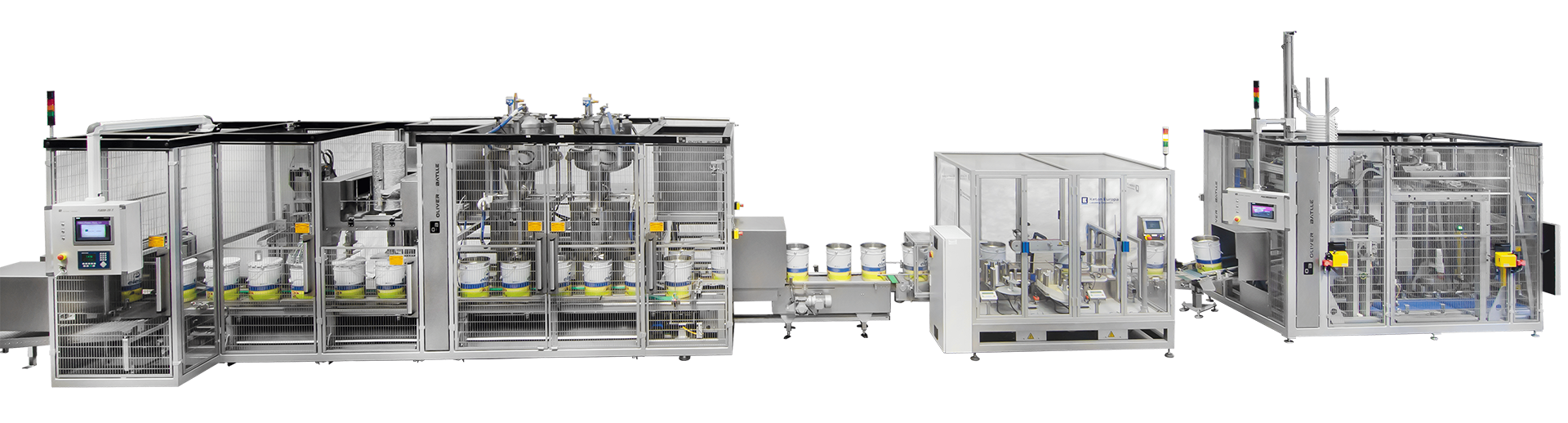
Oliver + Batlle supplied a fully integrated solution, combining precision filling technology with robust automation and handling systems.

Key components of the project included:

  • Pumping system: progressing cavity pumps installed beneath the product tanks, connected directly to the dosing heads for smooth and efficient product transfer.
  • Container handling:
    • Pail denester PAILMANAGER for conical stackable buckets.
    • Infeed table DB-SQ and conveyor for cylindrical cans.
  • Labelling: automatic labelling unit integrated into the line.
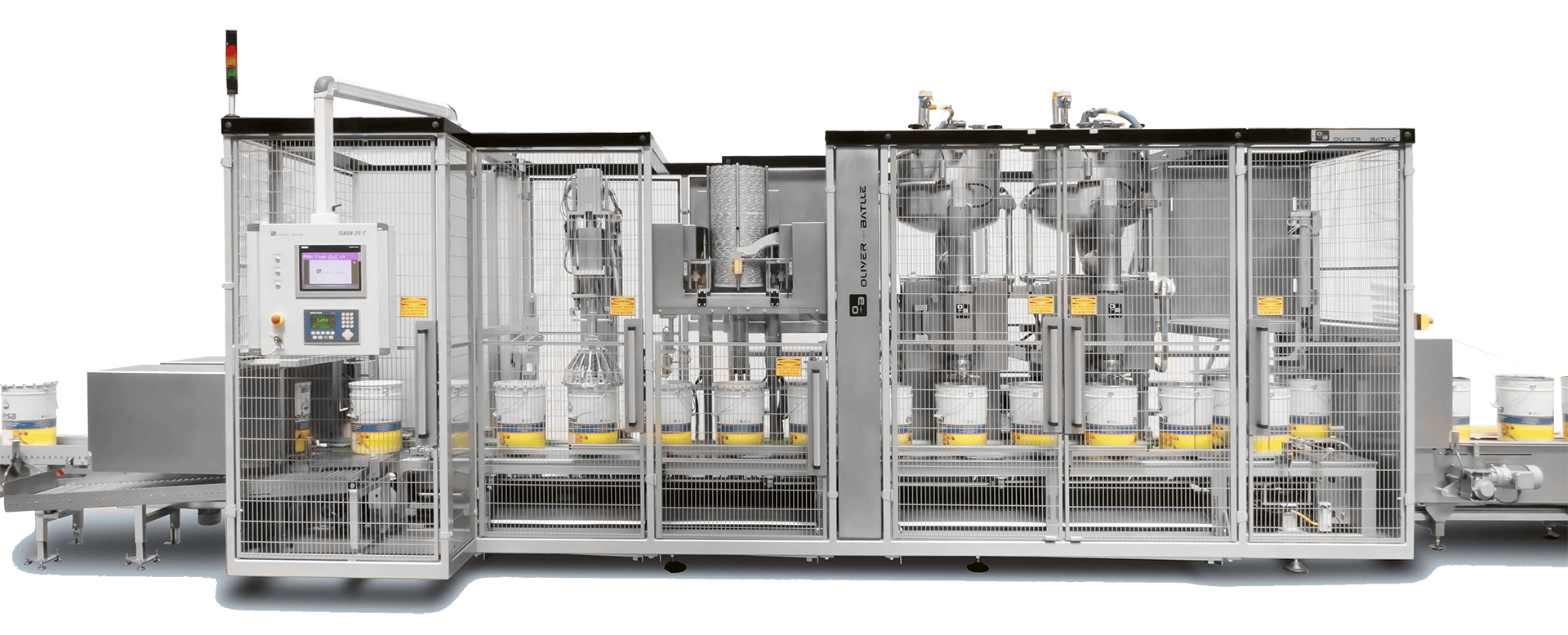
  • Filling and closing: FLASH-25-T filling line, including automatic lid placing, lid closing, and integrated checkweigher.
  • Automation: complete line with automatic format changeover for each machine.

Performance achieved:

  • Up to 20 containers/minute for 10 L buckets.
  • Up to 17 containers/minute for 20 L buckets.

Results achieved

The implementation of this solution has successfully met — and even exceeded — the customer’s expectations. The lines delivered:

  • High-speed performance: achieving the specified outputs with maximum accuracy.
  • Robust and reliable operation: guaranteeing long-term consistency without unplanned downtime.
  • Sustainable performance: aligned with Jotun’s strict quality and sustainability standards.

This project highlights Oliver + Batlle’s ability to design and implement turnkey filling solutions for high-viscosity stucco and putty products, ensuring efficiency, flexibility, and operational excellence.

Customer testimonial

“We are very satisfied with the project delivered by Oliver + Batlle. The installed filling lines have not only met but exceeded our expectations, achieving the desired filling rate and significantly improving operational efficiency. The solution is highly reliable and robust, with consistent performance and no failures.”


Solids-into-Oil-Based

In the technical materials industry—from plastics to specialized coatings—incorporating fine solids into oil-based systems poses a key challenge in terms of mixing and product stability. When working with highly viscous raw materials such as polybutene (PIB) or mineral oils, achieving a homogeneous dispersion, without incorporated air and with guaranteed long-term stability, requires precise process design and equipment adapted to the demands of the product.

In response to this challenge, OLIVER + BATLLE partnered with a client in the industrial plastics sector to co-develop and validate a tailored solution. The goal was to assess the technical feasibility of incorporating up to 4% fumed silica into two different oil-based formulations, while maintaining product homogeneity and ensuring scalability for industrial production.


Project Goal: Incorporate Fumed Silica into Oil-Based Carriers

The objective of the project was to develop a mixing process capable of incorporating up to 4% fumed silica into two distinct oil-based matrices:

  • Polybutene 
  • Mineral oil 

Both matrices are characterised by high viscosity, which makes it particularly challenging to disperse low-density solids while avoiding aeration and phase instability.

The key goals were:

  • Confirm the compatibility of OLIVER + BATLLE‘s dispersion systems with the chosen raw materials
  • Verify the efficiency and uniformity of the dispersion process
  • Demonstrate process viability on a pilot scale as a step toward industrial application

Step-by-Step Technical Solution: From Lab Testing to a Custom Pilot Unit

To meet the project requirements, OLIVER + BATLLE proposed a three-phase strategy that combined in-house lab testing, the development of a custom-built pilot mixer, and a full validation of the mixing process.

Phase 1 – Laboratory Trials

The initial testing phase took place in OLIVER + BATLLE‘s technical laboratory using a planetary mixer designed for high-viscosity media.

  • Multiple trials were conducted using different dispersion parameters and dosing sequences.
  • All tests were recorded and shared with the client for remote review.
  • Results exceeded expectations, delivering a homogeneous dispersion with no air entrapment or visible separation.

Phase 2 – Design and Delivery of a Custom Pilot System

Based on the successful lab tests, OLIVER + BATLLE designed and manufactured a bespoke pilot solution:

  • MPVDV-30 planetary mixer, adapted to the rheological requirements of the formulation.
  • Integrated vacuum powder loading system, enabling clean, safe incorporation of solids.
  • Plug & play configuration, compatible with the client’s R&D lab environment.

This pilot system was built to simulate full-scale production conditions while maintaining flexibility and ease of operation.

Phase 3 – Joint Validation (FAT + SAT)

The pilot unit was temporarily installed at OLIVER + BATLLE’s facility to carry out joint validation sessions with the client (FAT and SAT).

  • A total of 8 real product batches were produced during this phase.
  • Dispersion performance, final product quality and vacuum loading efficiency were thoroughly evaluated.
  • The tests confirmed the robustness of the system and its suitability for further scaling.

Project Outcomes: Efficient Solid Dispersion Without Defects

The project successfully met all its defined targets, with the following key outcomes:

  • Full process validation with client raw materials
  • Efficient incorporation of solids without air or visible defects
  • Custom-designed pilot mixer tailored to product viscosity
  • Smooth transition from lab trials to industrial-scale production
  • Client now fully equipped to continue development in-house

Conclusion: A Reliable Mixing Solution for Oil-Based Systems with Fine Solids

This project showcases how a combination of technical expertise, in-house validation and tailored equipment design enables industrial clients to solve complex formulation challenges. The incorporation of fumed silica into high-viscosity oil carriers is not only possible-it can be done efficiently and repeatably with the right process design and dispersion system.

Thanks to this collaboration, the client is now equipped with a validated, reliable solution for continued product development under real operating conditions.


1. Brief company description

Oliver + Batlle works in collaboration with a company specializing in the production of emulsifiers (paraffin emulsions), moisturizing agents, and solutions formulated with fats, waxes, and oils for the cosmetics, pharmaceutical, and home care sectors. Its focus is on sustainable innovation and the development of customized products designed to meet the specific needs of each industrial client.

2. Product to be processed

Paraffin-in-water emulsion, produced through a phase inversion process (W/O -> O/W), with 50% resin content.

The process begins with melting and mixing high-viscosity solids and ends with a fluid emulsion after the critical inversion phase. This variation in viscosity requires a custom-designed anchor agitator and heating at temperatures above 150°C.


3. Objective

Starting from a consolidated laboratory process for manufacturing this complex emulsion, the need was to scale it up to an industrial level.

The goal was to achieve a stable dispersion of 50% resin via phase inversion, while avoiding foam formation.

The main technical challenge appeared in the pre-inversion stage, where the product is especially viscous and difficult to mix Additionally, temperature control and water feed rate were identified as critical factors for final product stability.

4. O+B SOLUTION

OLIVER + BATLLE proposed a co-development strategy with the customer, using its in-house pilot plant to validate the mixing system design and tailor the equipment to the product’s characteristics.

Phase 1 – Pilot trials

Three pilot trials were carried out on a 150 L Polimix system, configured with a custom anchor (slow shaft) and a high-speed disperser (coaxial configuration).

The trials used thermal oil at over 150 °C to reach the required process temperature.

The goal was to validate the mixing capacity for achieving stable phase inversion.

Results:

  • Phase inversion was successfully achieved.
  • Some stability issues were detected in the batches compared to the target sample, attributed to process parameters (temperature and water flow) rather than the mixing system.
  • Equipment performance was excellent in terms of viscosity handling and behavior under critical conditions.
Phase 2 – Final solution

After confirming the technical feasibility, the customer acquired:

  1. 1 pilot unit VF-11 Special, with custom-designed anchor
  2. 1 thermal oil heater for the VF-11
  3. 1 production unit DPS-6000-OR Special, also equipped with the same custom agitator system and prepared for steam heating


During the manufacturing phase, the customer maintained access to the O+B pilot lab to continue developing the product, ensuring a smooth transition from pilot to industrial scale.


5. Results

  • Validation of the phase inversion process in a simulated industrial environment
  • Custom anchor design tailored to the emulsion’s mixing needs
  • Successful scale-up from laboratory to industrial equipment
  • Reduced technical risk thanks to joint development using O+B’s lab
  • Equipment currently installed and operational at the customer’s plant.


1. BRIEF DESCRIPTION OF THE CLIENT

An international textile-sector company with a highly integrated and sustainable insfrastructure, dedicated to the manufacture of high added-value products from recycled fibres and organic raw materials. With benchmark production capacity in its market, its industrial strategy prioritises efficiency, innovation, and the independence of key processes.

2. PRODUCT TO BE PROCESSED

Special resin used as a base component in formulations for technical textile applications.

3. OBJECTIVE

The client aimed to establish its own in-house production unit for this strategic resin, which had previously been purchased from external suppliers, in order to strengthen industrial autonomy and optimise production costs.

4. OLIVER + BATLLE SOLUTION

To address this challenge, Oliver + Batlle designed and implemented:

– 12,000-litre reactor for resin synthesis through monomer reaction, featuring:

  • Three-section half-coil for precise thermal control using steam and cooling water
  • Agitator shaft with two INTERMIG-type blades, Ø1850?mm
  • Semi-anchor Ø1700?mm
  • Construction material: AISI 316L stainless steel
  • Reactor working temperature: up to 150°C
  • Reactor working pressure: absolute vacuum to 3 bar g
  • Half-coil working temperature: up to 200°C
  • Half-coil working pressure: up to 10 bar g
  • 37 kW agitator motor with frequency converter

– Solids loading system using a screw conveyor, with sack and Big Bag unloading stations

– Complete process control system, including supervision of installation and commissioning on site


5. RESULTS

The project met the client’s needs with a robust, reliable and hygienic solution, ensuring consistent performance fully aligned with the highest quality standards.


accessories for the automation


1. COMPANY OVERVIEW

Sakata INX is a Japan-based multinational company and a global leader in the development and manufacture of printing inks.

Its Spanish subsidiary, Sakata INX España, S. A., operates a production facility offering a wide range of high-quality inks for the graphic sector. These products are manufactured using advanced technologies in varnish production and pigment dispersion, ensuring excellent performance and superior print quality.

The company’s commitment to innovation and continuous improvement has led it to modernise its manufacturing processes to meet the high standards of international markets.

2. PRODUCT TO BE PROCESSED

The project focused on optimising the production of a white printing ink, specifically designed for application on plastic packaging films.

This white ink acts as an opaque background layer, playing a key role in the final visual quality by enabling a clear and uniform reproduction of colours printed on top.

Due to its high opacity requirements, the formulation contains a high concentration of titanium dioxide (TiO?) — a pigment known for its covering power, but also for its high density, cost, and difficult handling properties.

3. PROJECT OBJECTIVES

Prior to implementing the new system, the unloading and dispersion of a single Big Bag of TiO? took approximately one hour, creating bottlenecks in the production line.

The client needed to significantly reduce this time without compromising product quality or operational safety.

Oliver + Batlle was tasked with developing a solution capable of:

  • Increasing the speed of TiO? dosing and dispersion.
  • Allowing for continuous, parallel operation to avoid production downtime.
  • Improving handling safety and cleanliness.
  • Maintaining or enhancing final product quality.

4. TECHNICAL SOLUTION IMPLEMENTED BU OLIVER + BATLLE

The solution integrates a high-capacity, safe and efficient powder handling system, a high-performance conical disperser, a pneumatic transfer and filtration group, and two gravimetric filling lines adapted to multiple packaging formats.

Powder handling system

  • Tubular screw conveyor made of carbon steel, with discharge outlet feeding into the disperser.
  • Driven by a 9.2kW motor.
  • Powder handling capacity: up to 13 ?m³/h
  • Three loading points:
    • Two Big Bag inlets, enabling parallel operation (while one bag is being emptied, the next is positioned for uninterrupted feeding)
    • One manual sack inlet, providing  flexibility for smaller batches or special formulations

Dispersion systems

  • POLIMIX DPS-7500-TRC conical disperser, engineered for large-scale, high-demand production
    • Total capacity: 7,500 litres
    • Main motor: 132 kW
    • Two dispersing blades: diameters 675 mm and 450 mm
    • Half-pipe cooling jacket for temperature control
    • Vertical condenser with a 2 heat exchange surface

The disperser design ensures effective incorporation of dense pigments and a highly homogeneous mixture. Its cylindro-conical geometry optimises product flow towards the dispersing blades and improves dispersion performance.

Automatic cleaning system

  • Motorised cleaning lance with rotating head
  • 3″ pneumatic pump fitted with particle filter
  • Nominal flow rate: 150 l/min

This system allows rapid and safe cleaning between batches, reducing downtime and avoiding cross-contamination.

Transfer and filtration

  • GBN12/SBF-0102 transfer and filtration unit, pneumatically driven (2″)
  • 31-litre basket filter with 200-micron mesh, ensuring product cleanliness prior to filling

Filling lines

Two gravimetric filling lines cover a wide range of formats:

1.PALLET 1500/G

  • For 200-litre drums and IBCs
  • Equipped with a floor scale rated up to 1,500 kg

2. OB-130

  • For cans up to 30 kg
  • Includes an integrated 30 kg scale


5. RESULTS ACHIEVED

The implementation of the new solution brought a significant improvement in production performance:

  • Over 60% reduction in TiO? unloading and dispersion time
  • Continuous operation enabled by dual Big Bag inlets, eliminating handling delays
  • Increased powder flow rate, outperforming the previous system
  • Higher productivity and process consistency, without compromising product quality
  • Improved safety and cleanliness, through a closed and automated solution

In summary, the collaboration between Sakata Ink España and Oliver + Batlle has resulted in a robust, high-capacity and efficient installation tailored to the demanding needs of white ink production.

It is a flexible, high-performance solution that ensures top-quality standards in one of the most critical areas of the printing ink manufacturing process.