Automation of additive dosing for the manufacture of water-based coatings: Puma Group case study
Puma Group and its coatings division
Grupo Puma is a leading business group in the construction materials sector and the largest manufacturer of mortars in Spain. With over 40 years of experience, it develops a wide range of solutions for construction, including adhesives, insulation systems, flooring, asphalt products and renovation solutions.
The group also has a division specialising in coatings, both water-based and solvent-based, for the manufacture of waterproofing and decorative paints for façades and fillers that can be applied to different surfaces. It currently has 37 production centres and a distribution network spanning four continents.
Product to be processed and project objective
The client manufactures coatings and coverings mainly for the construction sector. Within the framework of this project, the installation of additives is intended for the production of water-based coatings.
The incorporation of additives during the manufacture of paints and coatings is common practice in the industry, as they allow various properties of the final product to be adjusted and improved. Their functions include improving the dispersion of pigments and fillers (dispersants), controlling foam generated during the process (defoamers), stabilising the system by adjusting the pH, and providing specific properties such as biological resistance, gloss control, or modification of drying times.
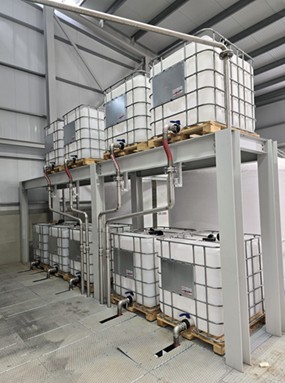
These additives are normally used in small quantities and are incorporated at different stages of the manufacturing process, which requires precise and repeatable dosing to ensure the quality and homogeneity of the final product. They are usually supplied in industrial containers such as IBCs or 200-litre drums, so in many plants weighing and addition are done manually.
In this context, the aim of the project was to design and implement an automated system capable of managing the weighing and precise dosing of different additives into eight independent dispersion tanks. The installation had to guarantee speed, accuracy and repeatability in the additions, integrating into the existing production process and allowing the direct use of IBCs as storage tanks for the additives. The aim was to avoid frequent transfer or replacement of containers, optimise internal raw material logistics and improve the overall efficiency of the manufacturing process.
Oliver + Batlle solution
To solve the challenge, Oliver + Batlle designed an automated additive dosing system comprising the following main elements:
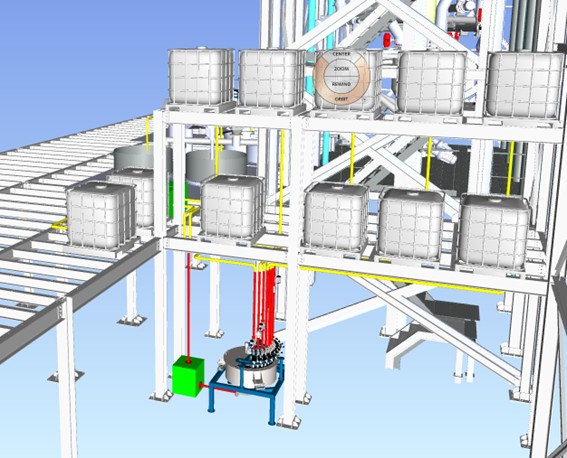
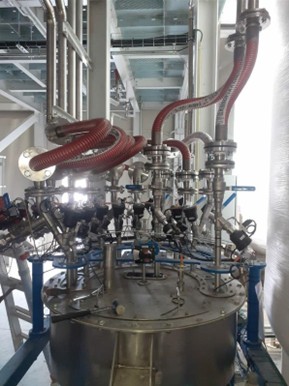
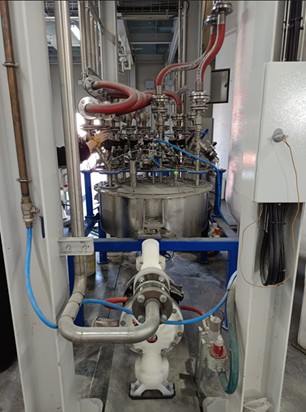
- A 300-litre additive weighing hopper, made of stainless steel and equipped with load cells. It incorporates automatic valves for dosing 11 different additives: 9 of them dosed by gravity and 2 by pumping, due to their higher viscosity. The system also has manual valves with micro-switches for loading the stock IBCs of each additive.
- Two pneumatic pumping units, designed for dosing higher viscosity additives.
- A pneumatic transfer pump, responsible for transferring the product from the weighing hopper to any of the eight possible destinations.
- A stainless steel distribution manifold equipped with seven automatic three-way valves, allowing the destination of the additive to be selected.
- Eight automatic line shut-off valves, installed at the inlet of each of the dispersion tanks.
- An electrical control and manoeuvring cabinet, equipped with a PLC and HMI touch screen, from which the operator can select the additive to be dosed, define the weight set point, manage stock loading and monitor the operation of the installation.
- Two portable pump units on trolleys, designed for loading IBCs of additive stock.
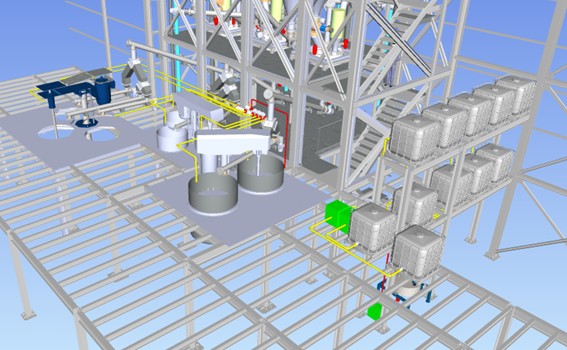
Oliver + Batlle carried out all the engineering work for implementation at the plant, including the distribution of the additive IBCs, the weighing hopper, the pumping equipment and the layout of the pipes from the hopper to the collector and from there to the dispersion tanks.
The mechanical, electrical and pneumatic assembly was carried out by the customer themselves, under the supervision of an O+B technician.
Subsequently, the installation was commissioned with the participation of a mechanical technician and an Oliver + Batlle programmer.
During operation, additives compatible with each other are dosed and weighed in the hopper, from where they are automatically transferred to the selected dispersion tank. The system also incorporates a water cleaning cycle for the hopper and flushing of the pipeline, ensuring that all the additives reach its destination.
The additive dosing control system was integrated into the factory’s automated system for executing complete recipes using the customer’s SCADA, establishing communication between the PLC of the system supplied by Oliver + Batlle and the plant’s main PLC.
3D views of the additive storage and distribution system: stock IBCs, 3-way valve manifold and piping to dispersion tanks
Results and advantages of the implemented solution
Thanks to the implementation of this automated additive dosing system, the customer has significantly optimised manufacturing times.
The process has gained in precision, cleanliness and repeatability, eliminating the variability associated with manual dosing.
In addition, the system provides complete traceability of the process, recording the dosages carried out for each batch, including the additive code, target value, actual dosage value, destination, date and time of the operation.
Automation has also reduced the operational workload, minimising manual interventions and facilitating the work of the plant operator.
The main advantages of the implemented solution are:
- Automation of the additive dosing process.
- Greater precision and repeatability in each manufacturing batch.
- Optimisation of process times.
- Improved cleanliness and order in the plant.
- Complete traceability of dosages performed.
- Reduction in operator workload.
- Integration with the existing control system through communication between PLCs.
- Direct use of IBCs as additive stock tanks, optimising internal logistics.
Do you need to automate dosing in your production plant?
At Oliver + Batlle, we specialise in process engineering design and customised automation for the chemical and coatings industry. From upgrading existing lines to designing turnkey production plants.
Contact our technical team today and find out how we can help you optimise your cycle times, improve traceability and make your manufacturing process more profitable.