1. BRIEF COMPANY DESCRIPTION

Bostik Australia Pty Ltd is a subsidiary of Bostik, a leading global adhesive technology company. Headquartered in Southbank, Victoria, Bostik Australia specializes in the manufacture of adhesives and sealants for a variety of sectors, including construction, industrial and consumer.

Its products range from do-it-yourself adhesives to advanced industrial solutions, such as leveling compounds and waterproofing products.

The company stands out for its commitment to innovation and sustainability, benefiting from the research and development capabilities of the Arkema Group, to which it belongs.

In addition, Bostik Australia has been present in the Australian market since 1915, offering solutions that improve people’s daily lives.

2. PRODUCT TO BE PROCESSED

High viscosity polyurethane (PU) sealant. It is characterized by its ability to form durable and flexible joints. These sealants are formulated with polyurethane resins and are commonly used in construction, automotive and other industries where reliable and durable sealing is required.


3. OBJECTIVE

The customer needed an open mixer to manufacture high viscosity PU sealant. The mixer was to be placed in an ATEX Zone 2 classified area.

Main customer requirements for the mixer: 

  • IECEx certification to comply with Australian regulations for ATEX zones.
  • Adaptation for use with existing tanks, already used in other similar equipment.
  • Head height position gauge.
  • Motorized tank holder.


4. O+B SOLUTION 

O+B proposed a mixer for mobile tanks model VFD-90 TV.

The main features of this mixer are:

  • Provided with two shafts. A fast dispersing shaft equipped with a saw-tooth disc and a slow mixing shaft equipped with a butterfly blade. 
  • Electro-hydraulic head lifting system.
  • Batch manufacturing capacity up to 1500L in portable tanks.
  • Vacuum lid adapted to the tank.
  • Clamp-type vessel holder.
  • Control panel with HMI screen for process control and recipe editing.

The standard equipment had to be modified to meet the customer’s requirements. The main modifications to the mechanical design of the equipment consisted of:

  • Modifying the column height in order to accommodate the customer’s tanks.
  • Modifying the lifting stroke.
  • Motorizing the clamp-type vessel holder.
  • Implementing a laser system to control the position of the head and to be able to use this data in the process control system.

The biggest challenge of the project was the IECEx certification of the equipment. Although there are many electrical and electromechanical components with such certification, there are very few complete pieces of equipment with such certification and little information about it.

Oliver + Batlle’s engineering and certification team contacted several Notified Bodies to carry out the IECEx certification of the mixer.


Finally, the work was carried out with the collaboration of TÜV as the Notified Body chosen for the project.


After completing the dossier, tests and the corresponding review, the IECEx certification of the equipment as a single model was obtained.

Thanks to our experience in adapting standard equipment to the needs of our clients, and the work done by the Oliver + Batlle team, BOSTIK Australia has an IECEx certified equipment that meets all their needs established in the project requirements.


5. RESULTS

The project succeeded in meeting the needs of the client, who now has a mixer capable of manufacturing their high viscosity products using both the new tanks supplied in the project, as well as the existing ones at BOSTIK Australia’s facilities. In addition, the project was complemented with customized process control software, which allows to control the main variables of the process.



accessories for the automation

Oliver + Batlle will participate in the European Coatings Show (ECS) 2025, the benchmark event for the paints and coatings industry, to be held in Nuremberg, Germany. In this edition, the company will exhibit two of its most innovative equipment: the Dispermix VFD-15 pilot disperser and the Mill-ennium RS-20 basket mill.

New 2025: Dispermix VFD-15 pilot mixer for the formulation and manufacture of high and medium viscosity products

The new Dispermix VFD-15 is designed for medium and high viscosity products in various industrial sectors. This pilot version, with a capacity of 60 liters, is available to customers in Oliver + Batlle’s workshops, allowing to validate manufacturing times for industrial batches of up to 2,000 liters.

Its main features include:

  • Vacuum or pressure generation to improve process efficiency.
  • Cooling systems for thermal control during operation.
  • Advanced instrumentation for continuous process control.
  • Different mixing tools according to product needs.

This equipment responds to market demand for solutions that optimize manufacturing times, ensuring more efficient and controlled processes.

Mill-ennium RS-20: evolution in milling technology

After 25 years of success and hundreds of units installed, the Mill-ennium RS-20 presents a renewed design that optimizes its performance and maintenance. This new version of the basket mill stands out for:

  • More compact design for better integration into production lines.
  • Automatic recipe management, facilitating repeatability and process control.
  • Reduced consumption of grinding spheres, optimizing operating costs.
  • Specialized versions for heat-sensitive and highly viscous products.

The Mill-ennium RS-20 is designed to improve efficiency in the grinding of paints and coatings, offering a flexible and energy efficient solution.

In addition, we will show you the latest in our most innovative solutions for complete packaging lines, designed to maximize efficiency, precision and automation in your production processes.

Visit our stand at ECS 2025

Oliver + Batlle invites all attendees to visit its stand at ECS 2025, Stand 4-156, where its technical and commercial team will be available to showcase these innovations and answer any questions.


For more information or to arrange a meeting during the fair, do not hesitate to contact us.

See you in Nuremberg!


accessories for the automation

The milling equipment being used in the manufacture of paints and inks is always purchased for the production of specific products. Frequently, with the passage of time, these products change formulations, raw materials (pigments), etc. The effectiveness of the grinding machines may vary after some change and it is at this moment when it is necessary to adapt the type of beads to be used. Let’s see what grinding elements we use in O+B mills and compare their performance with each other.


GRINDING ELEMENTS IN THE O+B MILLS


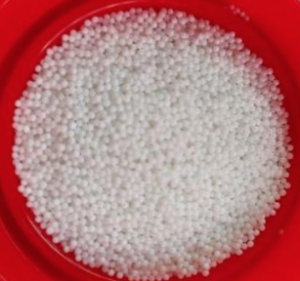
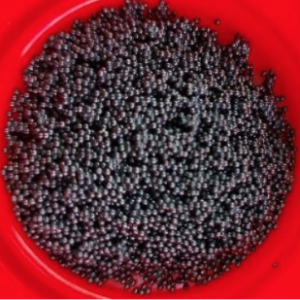
Comúnmente llamadas microesferas, sus características físicas determinan la efectividad de cualquier proceso de molienda.

Los tipos de microesferas utilizados habitualmente son los siguientes:

Commonly called microspheres, their physical characteristics determine the effectiveness of any grinding process.

The types of microspheres commonly used are as follows:

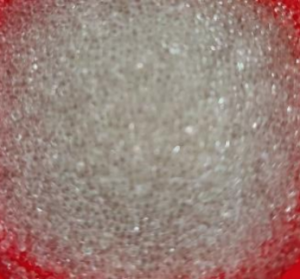
  1. Glass
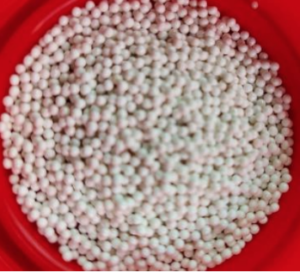
  2. Zirconium silicate, also called Zirconium silicate
  3. Yttrium-stabilized zirconium oxide, commonly called Yttria
  4. Tungsten carbide, also called tungsten carbidez


CHARACTERISTICS OF THE GRINDING ELEMENTS


Glass microspheres are almost entirely replaced by Zirconium or Ytrium.

Characteristics:

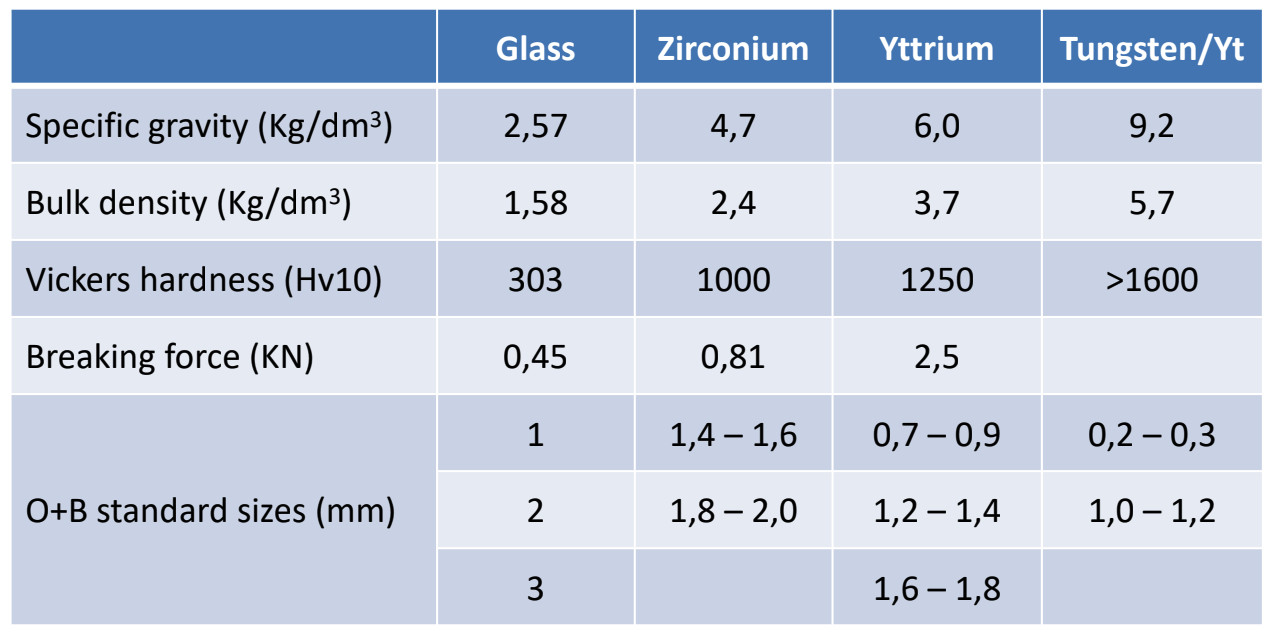
  • Material density: 2.57 Kg/dm3, apparent 1.58 Kg/dm3.
  • Vickers hardness: 303 HV 10
  • Diameters in stock O+B: 1, 2 and 3 mm


Zirconium microspheres marketed by O+B have the following characteristics:

  • Material density 4.7 Kg/dm3 (real), apparent 2.4 Kg/dm3.
  • Vickers hardness (*1): 1000 HV 10
  • DVickers hardness (*1): 1000 HV 10


Ytrium microspheres in O+B have the following characteristics:

  • Material density: 6 Kg/dm3, apparent 3.7 Kg/dm3
  • Vickers hardness: 1250 HV 1
  • Available diameters O+B : 0.7 – 0.9 mm,

1,2 – 1,4 mm and 1,6 – 1,8 mm


Tungsten microspheres are recently used in O+B and are in the testing phase. The characteristics are:

  • Material density: 9.2 Kg/dm3, apparent 5.7 Kg/dm3.
  • Vickers hardness: >1600 HV 0,5
  • Current test diameters: 1.0 – 1.2 mm


SUMMARY CHARACTERISTICS OF THE GRINDING ELEMENTS


COMPARISON OF THE DIFFERENT GRINDING ELEMENTS


1. In order to establish the comparison, two water-based bases were chosen for the manufacture of ink applicable to plastic substrates:

  • Black base: with a pigment content of 40% Carbon Black (inorganic).
  • Yellow base: with a pigment content of 41% of benzyl yellow (organic).

2. The mill used for this test was our 1/4” Pilotmill.

The configuration used in all cases has been:

  • 275 micron sieve
  • Turbo impeller
  • Cooling temperature selected at 5ºC
  • Product quantity of approximately 10 liters
  • Speeds maintained between 90-100% of maximum speed (1595rpm)

3. Comparison methodology:

  • Grinding was carried out for 3 hours, taking samples every 20 minutes.
  • The particle size was analyzed in a laser measuring equipment type Microtrac S3500.
  • The results obtained were plotted in graphs to visualize the differences between the different sizes and materials of the microspheres.
  • The values have been expressed differentiating the two types of pigments.


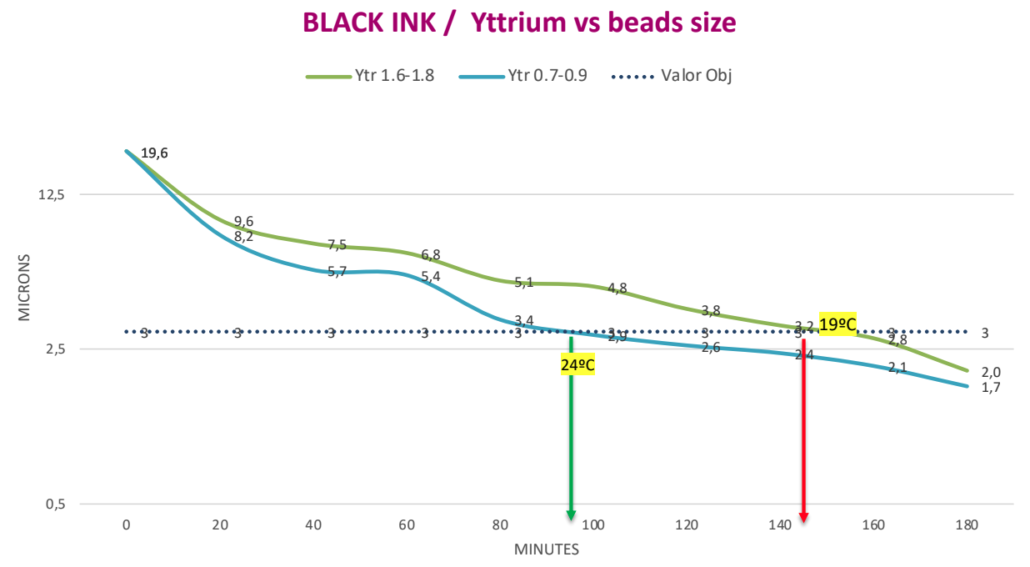
Targeted fineness 3 ?. Milling time with Yttrium beads 1,6 – 1,8 mm is 145 minutes. Milling time with Yttrium beads of 0,7 – 0,9 mm is 90 minutes. Time saving is 50 minutes or 34% of the milling time.


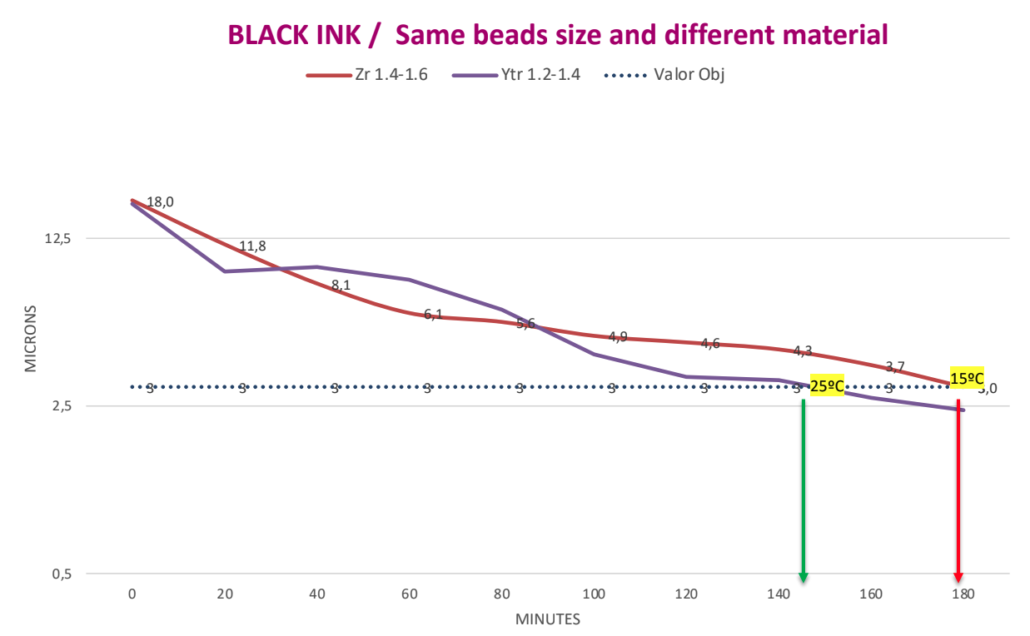
Targeted fineness 3 ?. Milling time with Yttrium beads 1.2 – 1.4 mm is 145 minutes. Milling time with Zirconium beads of 1.4 – 1.6 mm is 180 minutes. Time saving is 35 minutes or 19% of the milling time.


Targeted fineness 3 ?. Milling time with Tungsten beads 1.0 – 1.2 mm is 70 minutes. Milling time with Yttrium beads of 0.7 – 0.9 mm is 90 minutes. The time saving is 20 minutes or 26% of the milling time.Nano scale particles of 0.6 ? are reached within 165 minutes with Tungsten beads. It cannot be acjieved with Yttrium beads.


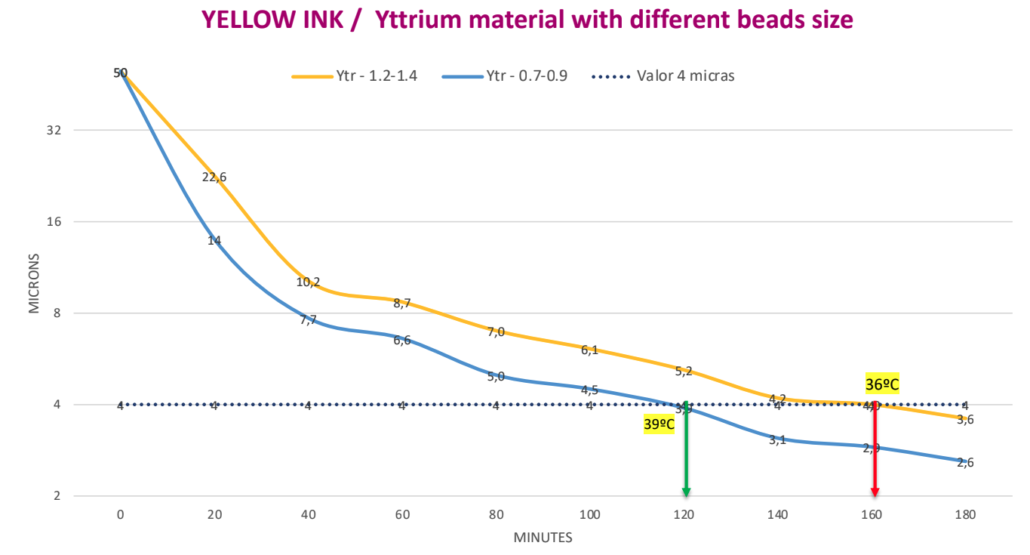
Targeted fineness 4 ?. Milling time with Yttrium beads 0.7 – 0.9 mm is 120 minutes. Milling time with Yttrium beads of 1.2 – 1.4 mm is 160 minutes. Time saving is 40 minutes or 25% of the milling time.


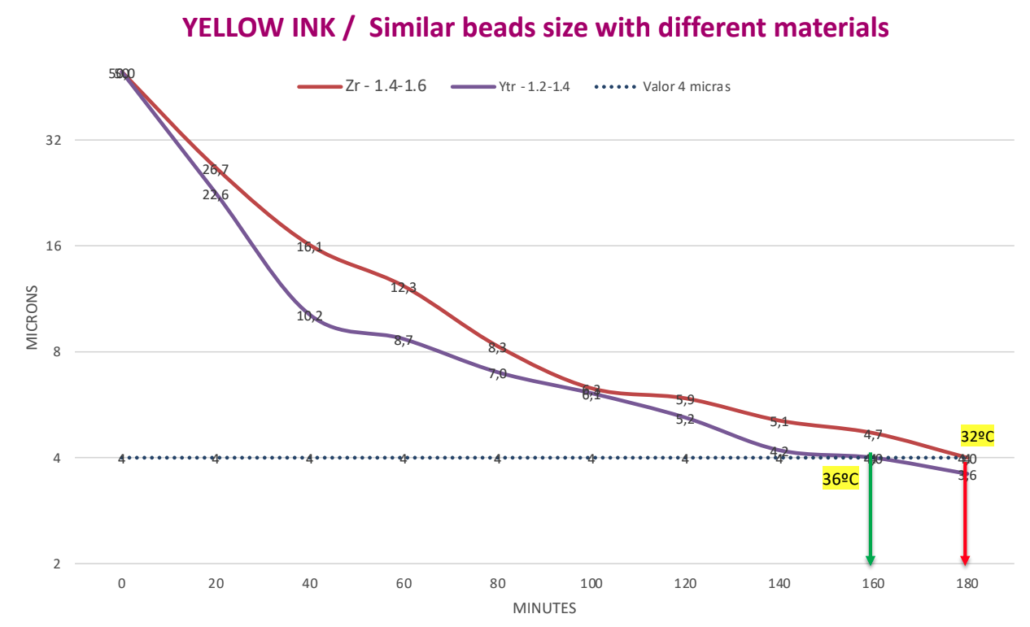
Targeted fineness 4 ?. Milling time with Zirconium beads 1.4 – 1.6 mm is 180 minutes. Milling time with Yttrium beads of 1.2 – 1.4 mm is 160 minutes. Time saving is 20 minutes or 11% of the milling time.


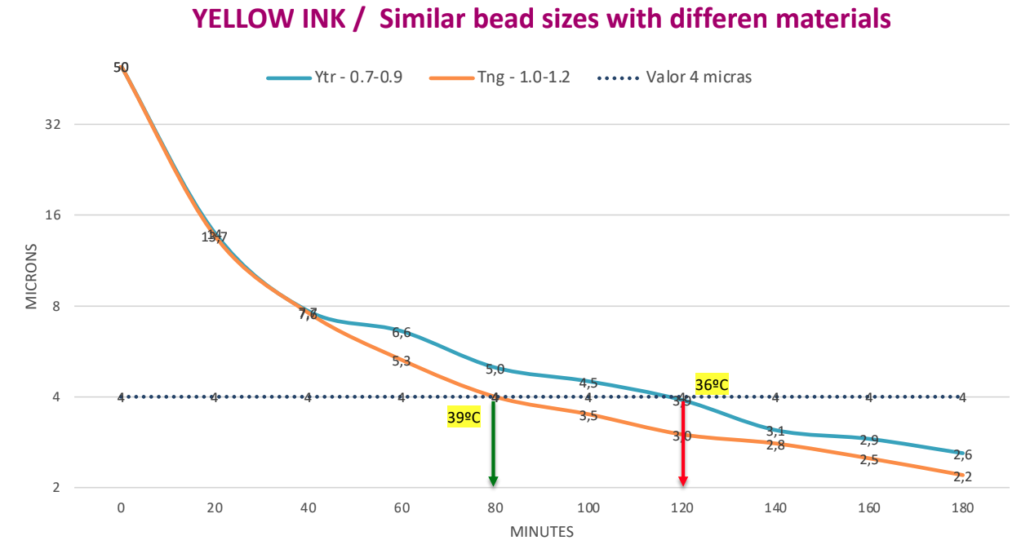
Targeted fineness 4 ?. Milling time with Tungsten beads 1.0 – 1.2 mm is 80 minutes. Milling time with Yttrium beads of 0.7 – 0.9 mm is 120 minutes. Time saving is 40 minutes or 33% of the milling time.


CONCLUSIONS BLACK & YELLOW: Zirconium, Yttrium or Tungsten


By using higher density Yttrium or Tungsten microspheres, greater effectiveness is achieved and we can see this by comparing the significant time savings.

The cost of Yttrium or Tungsten microspheres is higher than Zirconium microspheres.

  • In the case of carbon black to reach a size of 3 microns we have to:
    • Zirconium 1.4-1.6 takes 180 minutes.
    • Yttrium 1.2-1.4 takes 19% less.
    • Yttrium 0.7-0.9 takes 47% less.
    • Tungsten 1.0-1.2 takes 61% less.
  • In the case of yellow to reach a size of 4 microns we have to:
    • Zirconium 1.4-1.6 we take 180 minutes.
    • Ytrium 1.2-1.4 takes 11% less.
    • Yttrium 0.7-0.9 takes 33% less.
    • Tungsten 1.0-1.2 takes 56% less.

FINAL CONCLUSIONS

  • At a general level, we can say that obtaining the particle size will always depend on the nature of the pigment. And particle size reduction targets down to 3 or 4 microns can be obtained with any type of microspheres.
  • With the products tested, we can say that, at similar bead size, 3 or 4 micron sizes are best obtained with higher density beads such as Tungsten beads. This type of beads heat the products more and require more power from the equipment. Temperature increases can range from 5 to 10 oC depending on the product being processed and the recommended power increase would be 10%.
  • Ytrium beads of 0.7 – 0.9 mm offer good results. The current prices of these grinding elements allow a good balance of price and performance to be found. Many users have opted for the frequent use of this type of beads.


accessories for the automation

In a constantly evolving industrial environment, the automation of production systems has become a priority for manufacturers of paints, coatings, adhesives, sealants, etc. This trend responds to the need to optimize processes, ensure the correct repetition of formulas and improve traceability at each stage of manufacturing.


Given the continuous requests we receive from our customers to automate the dispersion and/or mixing phase, at OLIVER + BATLLE we have implemented a phase sequencer within an integrated control application in automated dispersers.

From the customer’s recipes, this software module allows to manage and control the manufacturing of recipes, divided into clearly defined phases or stages, offering an efficient and adaptable solution to the production demands.

For the development of this functionality, two modes are generally proposed that are integrated into the existing HMI system of the machine, facilitating operator interaction and ensuring compliance with the recipe specifications:

This solution not only improves manufacturing precision, but also enhances flexibility and adaptability to the specific requirements of each formula, marking a step forward in automation in the industrial sector.

Results

The possibility that, during production, the operator can adapt or modify the instructions of the recipe in progress according to the results obtained in the quality controls and save them, improves the precision of the product for subsequent productions.

Also, thanks to the fact that the sequencer generates data files (logs) in Microsoft Excel format on the machine’s HMI when the batch is being executed, the quality manager can analyze these data and check the actions that the operator has performed during the process, thus obtaining total traceability of the production.

The phase sequencer can be applied in other machines and other systems where repetitive programmable consecutive actions or phases with different parameters are required, such as DISPERMIX or POLIMIX mixer-dispersers, HIDROBAT planetary mixers, etc.

Customers are very satisfied with the versatility and functionality of the module.


accessories for the automation


JOTUN is a global manufacturer of decorative, industrial, marine and protective paints and coatings.

Founded in 1926 in Norway, Jotun operates in more than 100 countries and is recognized for innovation and sustainability. Its products include:

  1. Pinturas decorativas
  2. Industrial coatings
  3. Marine coatings
  4. Protective coatings

Jotun stands out for its focus on research and development, prioritizing sustainable and environmentally friendly solutions.


PRODUCT AND OBJECTIVE

The customer requested three complete lines for high-speed packaging, with the following requirements:

  • The product is water-based decorative paint, with density of 1.51 kg/dm³ and standard viscosity, designed for uniform application and optimum adhesion. Ideal for durable and resistant interior and exterior finishes. Batches from large capacity finishing tanks and packaged in 1L, 2.5L, 3.5L, 18L and 20L cans.
  • Two lines to process all formats, especially the larger ones.
  • One line only for 2.5L and 3.5L formats.
  • Cadences (containers per minute):
    • 1L (21-23 )
    • 2,5L (20-22)
    • 3,5L (19-21)
    • 18L (16-18)
    • 20L (15-17)
  • Control system integrated in the customer’s MONTH.


SOLUTION O+B

To achieve the objectives and requirements set by the client, O+B implemented the following solution:

  • Two packaging lines focused on large formats, consisting of the following equipment:
    •  PAILMANAGER container dispenser for conical (stackable) containers.
    •  DB-350-SQ feeding table for cylindrical containers (non-stackable).
    • KETAN EUROPE labeling machine for jars and cans.
    • FLASH-25 T volumetric filler for cans and jars from 1 to 20L.
  • A third packaging line focused on 2.5 and 3.5 liter formats, consisting of the following equipment:
    •  PAILMANAGER container dispenser for conical (stackable) containers.
    • FLASH-55 T volumetric filler for jars and cans from 1 to 5 L.
    • KETAN EUROPE labeling machine for jars and cans.

In the first two lines, the small formats of 1L, 2.5L and 3.5L are cylindrical and not stackable, so a DB-350-SQ feeding table is included, which allows feeding at the required rates with a single operator.

The 18- and 20-liter formats are conical, allowing them to be stacked and, therefore, managed automatically by PAILMANAGER, which unstacks them and delivers them to the labeling machine and then to the packaging machine.

On line three, the 2.5L and 3.5L cans are conical and stackable, and are therefore unstacked automatically by PAILMANAGER. In this case, the labeling machine is located downstream of the filler to ensure a better labeling process.

Both FLASH-25 T and FLASH-55 T packers work with a single hopper that feeds two heads, which dose 50% of the product into each pack in order to increase throughput.

All the packaging machines were equipped with a cleaning water heating system to reduce the cleaning cycle of the hopper and dosers, minimizing downtime between different production batches.

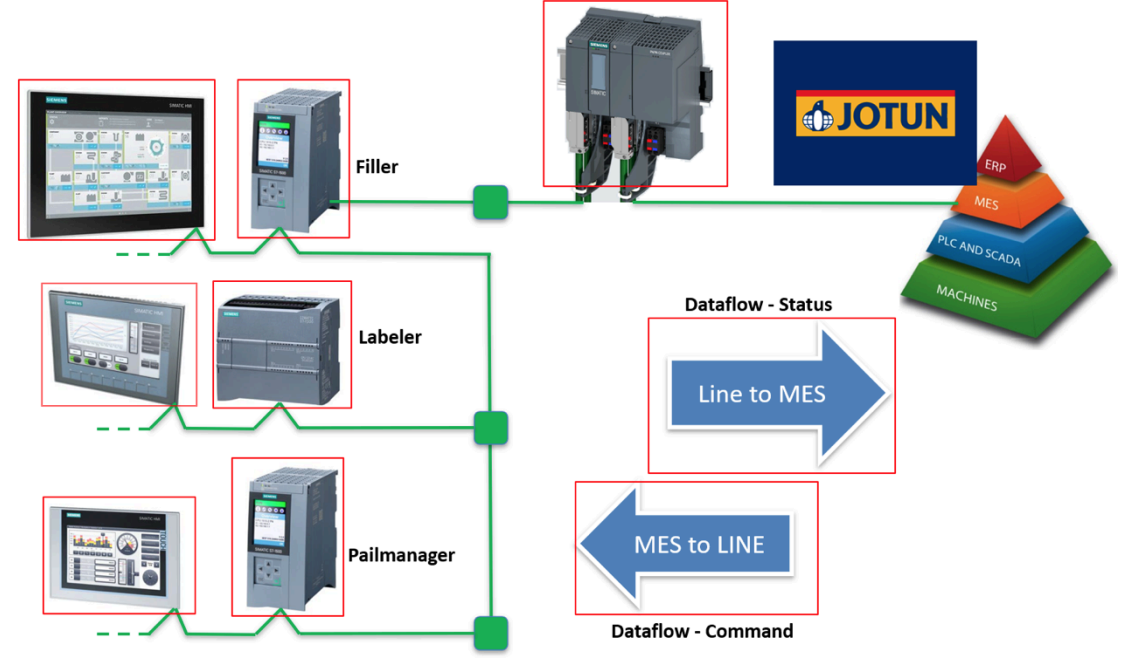
All elements of the packaging system communicate in real time with the customer’s MES.

The packaging machines are connected to the Emerson DCS system. The different systems are connected via Profinet protocol.

The packers send the following information to the system:

  • Recipe number of the product / Name of the selected product.
  • Machine speed.
  • Count of good products.
  • Count of rejected products.
  • Warning and alarm messages.
  • Status of the machine when running / stopped.
  • Machine status ready / not ready.

Jotun MES sends to the packers:

  • Order number.
  • Data for label printing.


RESULTS

The project was able to fully meet the customer’s needs, achieving the required packaging rate with precision and efficiency. The implemented solution stands out for its reliability and robustness, guaranteeing consistent performance.

The systems supplied by O+B provide a sustainable operation aligned with Jotun’s quality standards.


ROI

The system was installed on new lines in a newly constructed plant, so there is no direct comparison with a previous system. However, these packaging lines are managed by a single qualified operator and perform the equivalent work of five operators in a manual process. Taking into account labor costs and considering three shifts per day, the investment is recovered in less than two years.

In addition to a rapid return on investment, automatic packaging offers a much higher level of precision and accuracy than manual packaging, optimizing operational efficiency and minimizing waste.


CUSTOMER TESTIMONIAL

“We are very satisfied with the project delivered by Oliver + Batlle. The three packaging lines installed have exceeded our expectations, achieving the desired packaging rate and significantly improving operational efficiency. The solution is highly reliable and robust, with consistent and faultless performance.”

Guruh Susanto (Project Manager – Jotun)


accessories for the automation