Dosificado de pintura

In an increasingly efficiency-oriented industrial world, innovation is no longer a luxury, but a necessity. This became more than clear in the recent webinar we organized, where an ingenious and promising solution was presented: the use of 3D printed nozzles to optimize paint dosing.

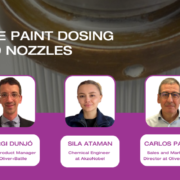
The session, led by our Commercial Director Carlos Pacha and starring Sergi Dunjó (product manager of the filling line) and Sila Ataman (plant chemical engineer at Azko Nobel), brought together an audience interested in advances in additive manufacturing applied to packaging equipment. And the premise was clear from the start: 3D technology is not the future, it’s the present.

From design to implementation: the technical path

Sergi Dunjó was in charge of explaining the most technical part of the project. He explained how the Oliver + Batlle team has integrated 3D printing in the redesign of nozzles for filling products of different viscosity. The focus, as he detailed, is on reducing filling cycles, improving accuracy and allowing greater adaptability in the process.

One of the most interesting aspects was the versatility of these nozzles: the same part can be used both with clamp clamping systems and with the new 3D-printed fasteners, which allows retrofits without the need to modify the entire machine.

From the lab to the plant: Sila’s testimony

For her part, Sila Ataman shared her first-hand experience in the plant during trials with these nozzles. Previously, several products were impossible to fill successfully, even after trying different types of conventional nozzles. “With this new nozzle, filling was smooth and successful,” he said. In addition, he noted that component cleanliness – one of the most uncertain points – was satisfactorily performed using the usual solvents. Although they have not yet tested color changes between cycles, Sila is confident that nozzle cleaning will not be a problem.

In conclusion, his recommendation was clear: “If you have products that are difficult to fill, give this nozzle a try”.

Concrete results and vision for the future

Among the most notable improvements, Sergi mentioned an increase of up to 20% in filling capacity, simply by integrating the printed nozzles into existing equipment. This not only means an increase in productivity, but also potential savings in operating costs.

When asked about the scope of 3D printing in other areas of filling equipment, he was blunt: “It’s not a technology of the future, it’s of the present. We are already using printed parts in other parts of the equipment with excellent results”.

As for commercial availability, it is still in the R&D phase, but a market launch is expected early next year.

Beyond the prototype

The event closed with an invitation to collaboration and open dialogue. Oliver + Batlle made it clear that its commitment to innovation does not stop at the prototype, but is designed to transform the coatings industry from its operational core.

A 3D printed nozzle may seem like a small change, but in the hands of a company that thinks big, it becomes a revolution.

 

Innovation and efficiency in pigment incorporation in the chemical sector

SIKA, founded in Switzerland in 1910, is a global leader in specialized chemical products for industries such as construction, automotive, and renewable energy. With operations in over 100 countries, the company stands out for its commitment to innovation, sustainability, and high performance across all its products.

SIKA’s product portfolio includes solutions for concrete additives, waterproofing, adhesives, repair and reinforcement of structures, as well as roofing and facade systems. Their commitment to quality and efficiency has enabled them to maintain a strong presence in the global market.

More information: SIKA

The challenge: Efficient pigment incorporation without compromising quality or efficiency

SIKA needed a solution to incorporate pigments hygienically and efficiently in the production of tinted oil, a key component in several of their products. Proper pigment suspension and dispersion in the oil are essential for ensuring high quality and consistency in the final product.

The specific requirements for the project included:

  • Avoiding dust emission during the operation.
  • Preventing cross-contamination between pigments while working with various shades.
  • Minimizing waste during the pigment incorporation process.
  • Ensuring minimal investment, with a focus on resource optimization.
  • Controlling a finished product viscosity range varying between 100cP and 20,000cP, which adds a challenge to maintaining both quality and flow of the mixture.

The O+B solution: Innovative technology tailored to customer needs

To address this challenge, O+B began with a phase of pilot plant tests to validate the technical feasibility of the proposed solution. These tests were essential for determining the key parameters of the process, focusing on two main aspects:

  • Determining the minimum pneumatic transport speed required to ensure that the pigments were properly transported to the mixer-disperser without losing efficiency.
  • Establishing the maximum speed to avoid the pigments transferring into the liquid, which would cause splashes and possible spillage.

With the results obtained from these tests, O+B proposed an optimized industrial solution that was also economical, involving a vacuum loading and dispersion system to incorporate 8 pigments efficiently and without contamination. This system was implemented in a Dispermix O+B, specifically designed to ensure a hygienic and precise process.

Start-up tests: Performance and efficiency in action

During the start-up phase of the solution, the following data was verified:

  • 300 kg of gray pigment incorporated in 20 minutes, meeting the system’s expected capacity.
  • Only 100 g of solid pigment passed through the filter, representing an 0.03% loss, an exceptionally low figure that highlights the efficiency and precision of the system.

    These tests confirmed that the system was highly efficient, maintaining the quality standards required by SIKA.

Results achieved: Performance, hygiene, and efficiency

The system implemented by O+B has allowed SIKA to achieve efficient pigment incorporation without contamination, resulting in a cleaner production process with minimal waste. The outcomes are as follows:

  • Reliability in the process, with controlled pigment incorporation.
  • Resource optimization, significantly reducing waste in the process.
  • Compliance with SIKA’s stringent quality standards, ensuring a homogeneous and consistent product.
  • Constant and safe performance, with a fully automated system that provides greater process control.
  • High operational efficiency, improving productivity and reducing downtime.

The technology implemented not only guarantees constant and secure performance but also optimizes the efficiency of every phase of the production process, from initial loading to final dispersion.

This project demonstrates how O+B can deliver innovative and tailored solutions that enhance quality, efficiency, and sustainability in industrial processes. The implementation of this technology has strengthened SIKA’s commitment to excellence, ensuring the highest quality in the production of tinted oils and other products.


accessories for the automation

1. BRIEF COMPANY DESCRIPTION

Bostik Australia Pty Ltd is a subsidiary of Bostik, a leading global adhesive technology company. Headquartered in Southbank, Victoria, Bostik Australia specializes in the manufacture of adhesives and sealants for a variety of sectors, including construction, industrial and consumer.

Its products range from do-it-yourself adhesives to advanced industrial solutions, such as leveling compounds and waterproofing products.

The company stands out for its commitment to innovation and sustainability, benefiting from the research and development capabilities of the Arkema Group, to which it belongs.

In addition, Bostik Australia has been present in the Australian market since 1915, offering solutions that improve people’s daily lives.

2. PRODUCT TO BE PROCESSED

High viscosity polyurethane (PU) sealant. It is characterized by its ability to form durable and flexible joints. These sealants are formulated with polyurethane resins and are commonly used in construction, automotive and other industries where reliable and durable sealing is required.


3. OBJECTIVE

The customer needed an open mixer to manufacture high viscosity PU sealant. The mixer was to be placed in an ATEX Zone 2 classified area.

Main customer requirements for the mixer: 

  • IECEx certification to comply with Australian regulations for ATEX zones.
  • Adaptation for use with existing tanks, already used in other similar equipment.
  • Head height position gauge.
  • Motorized tank holder.


4. O+B SOLUTION 

O+B proposed a mixer for mobile tanks model VFD-90 TV.

The main features of this mixer are:

  • Provided with two shafts. A fast dispersing shaft equipped with a saw-tooth disc and a slow mixing shaft equipped with a butterfly blade. 
  • Electro-hydraulic head lifting system.
  • Batch manufacturing capacity up to 1500L in portable tanks.
  • Vacuum lid adapted to the tank.
  • Clamp-type vessel holder.
  • Control panel with HMI screen for process control and recipe editing.

The standard equipment had to be modified to meet the customer’s requirements. The main modifications to the mechanical design of the equipment consisted of:

  • Modifying the column height in order to accommodate the customer’s tanks.
  • Modifying the lifting stroke.
  • Motorizing the clamp-type vessel holder.
  • Implementing a laser system to control the position of the head and to be able to use this data in the process control system.

The biggest challenge of the project was the IECEx certification of the equipment. Although there are many electrical and electromechanical components with such certification, there are very few complete pieces of equipment with such certification and little information about it.

Oliver + Batlle’s engineering and certification team contacted several Notified Bodies to carry out the IECEx certification of the mixer.


Finally, the work was carried out with the collaboration of TÜV as the Notified Body chosen for the project.


After completing the dossier, tests and the corresponding review, the IECEx certification of the equipment as a single model was obtained.

Thanks to our experience in adapting standard equipment to the needs of our clients, and the work done by the Oliver + Batlle team, BOSTIK Australia has an IECEx certified equipment that meets all their needs established in the project requirements.


5. RESULTS

The project succeeded in meeting the needs of the client, who now has a mixer capable of manufacturing their high viscosity products using both the new tanks supplied in the project, as well as the existing ones at BOSTIK Australia’s facilities. In addition, the project was complemented with customized process control software, which allows to control the main variables of the process.


accessories for the automation

In a constantly evolving industrial environment, the automation of production systems has become a priority for manufacturers of paints, coatings, adhesives, sealants, etc. This trend responds to the need to optimize processes, ensure the correct repetition of formulas and improve traceability at each stage of manufacturing.


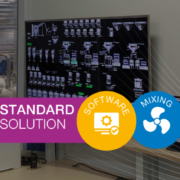
Given the continuous requests we receive from our customers to automate the dispersion and/or mixing phase, at OLIVER + BATLLE we have implemented a phase sequencer within an integrated control application in automated dispersers.

From the customer’s recipes, this software module allows to manage and control the manufacturing of recipes, divided into clearly defined phases or stages, offering an efficient and adaptable solution to the production demands.

For the development of this functionality, two modes are generally proposed that are integrated into the existing HMI system of the machine, facilitating operator interaction and ensuring compliance with the recipe specifications:

This solution not only improves manufacturing precision, but also enhances flexibility and adaptability to the specific requirements of each formula, marking a step forward in automation in the industrial sector.

Results

The possibility that, during production, the operator can adapt or modify the instructions of the recipe in progress according to the results obtained in the quality controls and save them, improves the precision of the product for subsequent productions.

Also, thanks to the fact that the sequencer generates data files (logs) in Microsoft Excel format on the machine’s HMI when the batch is being executed, the quality manager can analyze these data and check the actions that the operator has performed during the process, thus obtaining total traceability of the production.

The phase sequencer can be applied in other machines and other systems where repetitive programmable consecutive actions or phases with different parameters are required, such as DISPERMIX or POLIMIX mixer-dispersers, HIDROBAT planetary mixers, etc.

Customers are very satisfied with the versatility and functionality of the module.


accessories for the automation


Paint & Coatings, an international event bringing together the main companies working in the surface treatment and paint technology sector, will be held on 16 and 17 November at Fira Barcelona.

As a company specialised in developing machinery for manufacturing paint and related products, Oliver + Batlle will be present at the event, not only on the expo -where you can visit us at Stand 108-, but also at online events and webinars that will take place during the months leading up to the event. Let’s have a look at some of them.

Read more