Revolution in paint dispensing: Oliver + Batlle relies on 3D nozzles
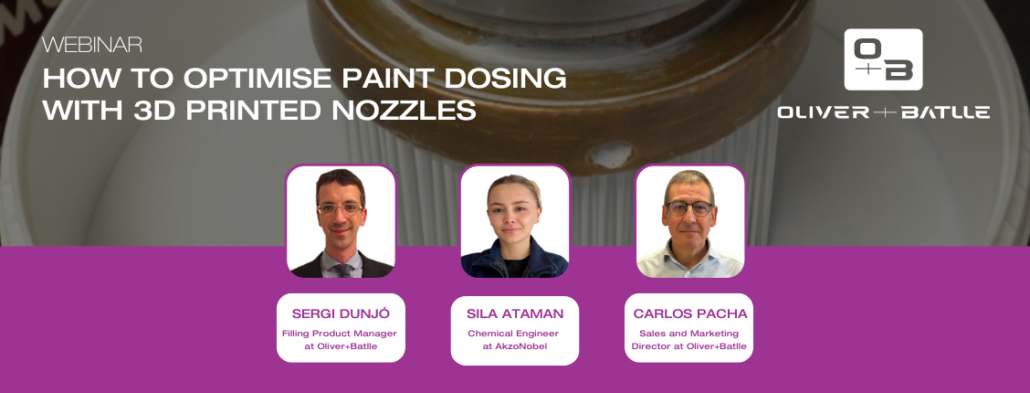
In an increasingly efficiency-oriented industrial world, innovation is no longer a luxury, but a necessity. This became more than clear in the recent webinar we organized, where an ingenious and promising solution was presented: the use of 3D printed nozzles to optimize paint dosing.
The session, led by our Commercial Director Carlos Pacha and starring Sergi Dunjó (product manager of the filling line) and Sila Ataman (plant chemical engineer at Azko Nobel), brought together an audience interested in advances in additive manufacturing applied to packaging equipment. And the premise was clear from the start: 3D technology is not the future, it’s the present.
From design to implementation: the technical path
Sergi Dunjó was in charge of explaining the most technical part of the project. He explained how the Oliver + Batlle team has integrated 3D printing in the redesign of nozzles for filling products of different viscosity. The focus, as he detailed, is on reducing filling cycles, improving accuracy and allowing greater adaptability in the process.
One of the most interesting aspects was the versatility of these nozzles: the same part can be used both with clamp clamping systems and with the new 3D-printed fasteners, which allows retrofits without the need to modify the entire machine.
From the lab to the plant: Sila’s testimony
For her part, Sila Ataman shared her first-hand experience in the plant during trials with these nozzles. Previously, several products were impossible to fill successfully, even after trying different types of conventional nozzles. “With this new nozzle, filling was smooth and successful,” he said. In addition, he noted that component cleanliness – one of the most uncertain points – was satisfactorily performed using the usual solvents. Although they have not yet tested color changes between cycles, Sila is confident that nozzle cleaning will not be a problem.
In conclusion, his recommendation was clear: “If you have products that are difficult to fill, give this nozzle a try”.
Concrete results and vision for the future
Among the most notable improvements, Sergi mentioned an increase of up to 20% in filling capacity, simply by integrating the printed nozzles into existing equipment. This not only means an increase in productivity, but also potential savings in operating costs.
When asked about the scope of 3D printing in other areas of filling equipment, he was blunt: “It’s not a technology of the future, it’s of the present. We are already using printed parts in other parts of the equipment with excellent results”.
As for commercial availability, it is still in the R&D phase, but a market launch is expected early next year.
Beyond the prototype
The event closed with an invitation to collaboration and open dialogue. Oliver + Batlle made it clear that its commitment to innovation does not stop at the prototype, but is designed to transform the coatings industry from its operational core.
A 3D printed nozzle may seem like a small change, but in the hands of a company that thinks big, it becomes a revolution.