1. Brief company description

Oliver + Batlle works in collaboration with a company specializing in the production of emulsifiers (paraffin emulsions), moisturizing agents, and solutions formulated with fats, waxes, and oils for the cosmetics, pharmaceutical, and home care sectors. Its focus is on sustainable innovation and the development of customized products designed to meet the specific needs of each industrial client.

2. Product to be processed

Paraffin-in-water emulsion, produced through a phase inversion process (W/O -> O/W), with 50% resin content.

The process begins with melting and mixing high-viscosity solids and ends with a fluid emulsion after the critical inversion phase. This variation in viscosity requires a custom-designed anchor agitator and heating at temperatures above 150°C.


3. Objective

Starting from a consolidated laboratory process for manufacturing this complex emulsion, the need was to scale it up to an industrial level.

The goal was to achieve a stable dispersion of 50% resin via phase inversion, while avoiding foam formation.

The main technical challenge appeared in the pre-inversion stage, where the product is especially viscous and difficult to mix Additionally, temperature control and water feed rate were identified as critical factors for final product stability.

4. O+B SOLUTION

OLIVER + BATLLE proposed a co-development strategy with the customer, using its in-house pilot plant to validate the mixing system design and tailor the equipment to the product’s characteristics.

Phase 1 – Pilot trials

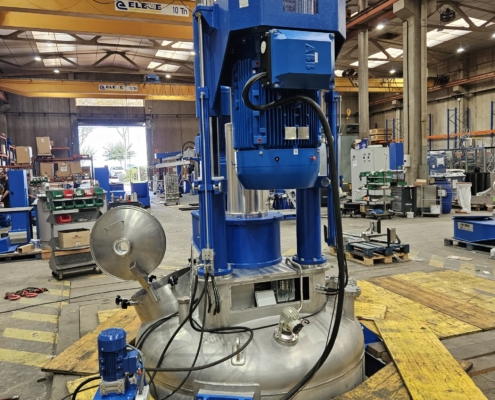
Three pilot trials were carried out on a 150 L Polimix system, configured with a custom anchor (slow shaft) and a high-speed disperser (coaxial configuration).

The trials used thermal oil at over 150 °C to reach the required process temperature.

The goal was to validate the mixing capacity for achieving stable phase inversion.

Results:

  • Phase inversion was successfully achieved.
  • Some stability issues were detected in the batches compared to the target sample, attributed to process parameters (temperature and water flow) rather than the mixing system.
  • Equipment performance was excellent in terms of viscosity handling and behavior under critical conditions.
Phase 2 – Final solution

After confirming the technical feasibility, the customer acquired:

  1. 1 pilot unit VF-11 Special, with custom-designed anchor
  2. 1 thermal oil heater for the VF-11
  3. 1 production unit DPS-6000-OR Special, also equipped with the same custom agitator system and prepared for steam heating


During the manufacturing phase, the customer maintained access to the O+B pilot lab to continue developing the product, ensuring a smooth transition from pilot to industrial scale.


5. Results

  • Validation of the phase inversion process in a simulated industrial environment
  • Custom anchor design tailored to the emulsion’s mixing needs
  • Successful scale-up from laboratory to industrial equipment
  • Reduced technical risk thanks to joint development using O+B’s lab
  • Equipment currently installed and operational at the customer’s plant.


1. BRIEF DESCRIPTION OF THE CLIENT

An international textile-sector company with a highly integrated and sustainable insfrastructure, dedicated to the manufacture of high added-value products from recycled fibres and organic raw materials. With benchmark production capacity in its market, its industrial strategy prioritises efficiency, innovation, and the independence of key processes.

2. PRODUCT TO BE PROCESSED

Special resin used as a base component in formulations for technical textile applications.

3. OBJECTIVE

The client aimed to establish its own in-house production unit for this strategic resin, which had previously been purchased from external suppliers, in order to strengthen industrial autonomy and optimise production costs.

4. OLIVER + BATLLE SOLUTION

To address this challenge, Oliver + Batlle designed and implemented:

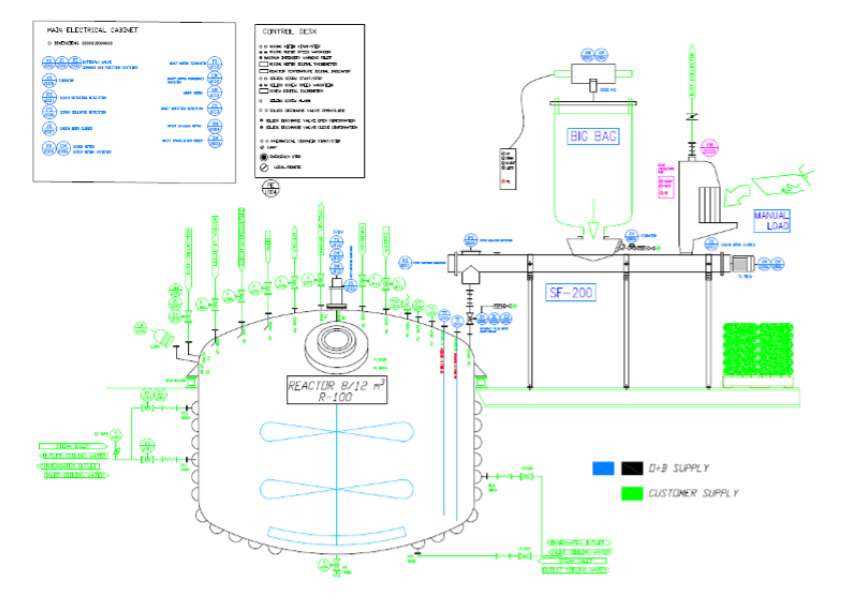
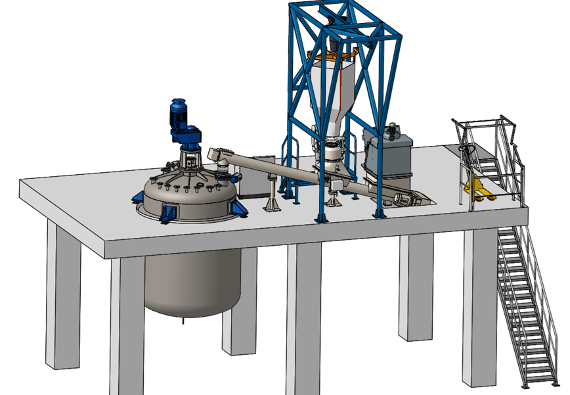
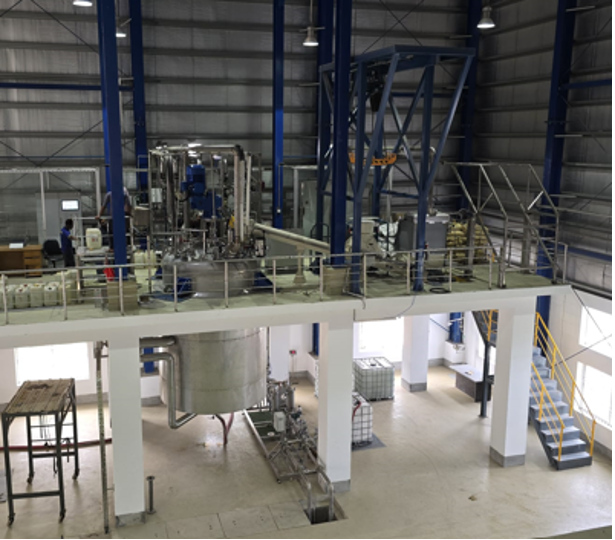
– 12,000-litre reactor for resin synthesis through monomer reaction, featuring:

  • Three-section half-coil for precise thermal control using steam and cooling water
  • Agitator shaft with two INTERMIG-type blades, Ø1850?mm
  • Semi-anchor Ø1700?mm
  • Construction material: AISI 316L stainless steel
  • Reactor working temperature: up to 150°C
  • Reactor working pressure: absolute vacuum to 3 bar g
  • Half-coil working temperature: up to 200°C
  • Half-coil working pressure: up to 10 bar g
  • 37 kW agitator motor with frequency converter

– Solids loading system using a screw conveyor, with sack and Big Bag unloading stations

– Complete process control system, including supervision of installation and commissioning on site


5. RESULTS

The project met the client’s needs with a robust, reliable and hygienic solution, ensuring consistent performance fully aligned with the highest quality standards.


accessories for the automation


1. COMPANY OVERVIEW

Sakata INX is a Japan-based multinational company and a global leader in the development and manufacture of printing inks.

Its Spanish subsidiary, Sakata INX España, S. A., operates a production facility offering a wide range of high-quality inks for the graphic sector. These products are manufactured using advanced technologies in varnish production and pigment dispersion, ensuring excellent performance and superior print quality.

The company’s commitment to innovation and continuous improvement has led it to modernise its manufacturing processes to meet the high standards of international markets.

2. PRODUCT TO BE PROCESSED

The project focused on optimising the production of a white printing ink, specifically designed for application on plastic packaging films.

This white ink acts as an opaque background layer, playing a key role in the final visual quality by enabling a clear and uniform reproduction of colours printed on top.

Due to its high opacity requirements, the formulation contains a high concentration of titanium dioxide (TiO?) — a pigment known for its covering power, but also for its high density, cost, and difficult handling properties.

3. PROJECT OBJECTIVES

Prior to implementing the new system, the unloading and dispersion of a single Big Bag of TiO? took approximately one hour, creating bottlenecks in the production line.

The client needed to significantly reduce this time without compromising product quality or operational safety.

Oliver + Batlle was tasked with developing a solution capable of:

  • Increasing the speed of TiO? dosing and dispersion.
  • Allowing for continuous, parallel operation to avoid production downtime.
  • Improving handling safety and cleanliness.
  • Maintaining or enhancing final product quality.

4. TECHNICAL SOLUTION IMPLEMENTED BU OLIVER + BATLLE

The solution integrates a high-capacity, safe and efficient powder handling system, a high-performance conical disperser, a pneumatic transfer and filtration group, and two gravimetric filling lines adapted to multiple packaging formats.

Powder handling system

  • Tubular screw conveyor made of carbon steel, with discharge outlet feeding into the disperser.
  • Driven by a 9.2kW motor.
  • Powder handling capacity: up to 13 ?m³/h
  • Three loading points:
    • Two Big Bag inlets, enabling parallel operation (while one bag is being emptied, the next is positioned for uninterrupted feeding)
    • One manual sack inlet, providing  flexibility for smaller batches or special formulations

Dispersion systems

  • POLIMIX DPS-7500-TRC conical disperser, engineered for large-scale, high-demand production
    • Total capacity: 7,500 litres
    • Main motor: 132 kW
    • Two dispersing blades: diameters 675 mm and 450 mm
    • Half-pipe cooling jacket for temperature control
    • Vertical condenser with a 2 heat exchange surface

The disperser design ensures effective incorporation of dense pigments and a highly homogeneous mixture. Its cylindro-conical geometry optimises product flow towards the dispersing blades and improves dispersion performance.

Automatic cleaning system

  • Motorised cleaning lance with rotating head
  • 3″ pneumatic pump fitted with particle filter
  • Nominal flow rate: 150 l/min

This system allows rapid and safe cleaning between batches, reducing downtime and avoiding cross-contamination.

Transfer and filtration

  • GBN12/SBF-0102 transfer and filtration unit, pneumatically driven (2″)
  • 31-litre basket filter with 200-micron mesh, ensuring product cleanliness prior to filling

Filling lines

Two gravimetric filling lines cover a wide range of formats:

1.PALLET 1500/G

  • For 200-litre drums and IBCs
  • Equipped with a floor scale rated up to 1,500 kg

2. OB-130

  • For cans up to 30 kg
  • Includes an integrated 30 kg scale


5. RESULTS ACHIEVED

The implementation of the new solution brought a significant improvement in production performance:

  • Over 60% reduction in TiO? unloading and dispersion time
  • Continuous operation enabled by dual Big Bag inlets, eliminating handling delays
  • Increased powder flow rate, outperforming the previous system
  • Higher productivity and process consistency, without compromising product quality
  • Improved safety and cleanliness, through a closed and automated solution

In summary, the collaboration between Sakata Ink España and Oliver + Batlle has resulted in a robust, high-capacity and efficient installation tailored to the demanding needs of white ink production.

It is a flexible, high-performance solution that ensures top-quality standards in one of the most critical areas of the printing ink manufacturing process.


Dosificado de pintura

In an increasingly efficiency-oriented industrial world, innovation is no longer a luxury, but a necessity. This became more than clear in the recent webinar we organized, where an ingenious and promising solution was presented: the use of 3D printed nozzles to optimize paint dosing.

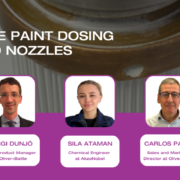
The session, led by our Commercial Director Carlos Pacha and starring Sergi Dunjó (product manager of the filling line) and Sila Ataman (plant chemical engineer at Azko Nobel), brought together an audience interested in advances in additive manufacturing applied to packaging equipment. And the premise was clear from the start: 3D technology is not the future, it’s the present.

From design to implementation: the technical path

Sergi Dunjó was in charge of explaining the most technical part of the project. He explained how the Oliver + Batlle team has integrated 3D printing in the redesign of nozzles for filling products of different viscosity. The focus, as he detailed, is on reducing filling cycles, improving accuracy and allowing greater adaptability in the process.

One of the most interesting aspects was the versatility of these nozzles: the same part can be used both with clamp clamping systems and with the new 3D-printed fasteners, which allows retrofits without the need to modify the entire machine.

From the lab to the plant: Sila’s testimony

For her part, Sila Ataman shared her first-hand experience in the plant during trials with these nozzles. Previously, several products were impossible to fill successfully, even after trying different types of conventional nozzles. “With this new nozzle, filling was smooth and successful,” he said. In addition, he noted that component cleanliness – one of the most uncertain points – was satisfactorily performed using the usual solvents. Although they have not yet tested color changes between cycles, Sila is confident that nozzle cleaning will not be a problem.

In conclusion, his recommendation was clear: “If you have products that are difficult to fill, give this nozzle a try”.

Concrete results and vision for the future

Among the most notable improvements, Sergi mentioned an increase of up to 20% in filling capacity, simply by integrating the printed nozzles into existing equipment. This not only means an increase in productivity, but also potential savings in operating costs.

When asked about the scope of 3D printing in other areas of filling equipment, he was blunt: “It’s not a technology of the future, it’s of the present. We are already using printed parts in other parts of the equipment with excellent results”.

As for commercial availability, it is still in the R&D phase, but a market launch is expected early next year.

Beyond the prototype

The event closed with an invitation to collaboration and open dialogue. Oliver + Batlle made it clear that its commitment to innovation does not stop at the prototype, but is designed to transform the coatings industry from its operational core.

A 3D printed nozzle may seem like a small change, but in the hands of a company that thinks big, it becomes a revolution.


Innovation and efficiency in pigment incorporation in the chemical sector

SIKA, founded in Switzerland in 1910, is a global leader in specialized chemical products for industries such as construction, automotive, and renewable energy. With operations in over 100 countries, the company stands out for its commitment to innovation, sustainability, and high performance across all its products.

SIKA’s product portfolio includes solutions for concrete additives, waterproofing, adhesives, repair and reinforcement of structures, as well as roofing and facade systems. Their commitment to quality and efficiency has enabled them to maintain a strong presence in the global market.

More information: SIKA

The challenge: Efficient pigment incorporation without compromising quality or efficiency

SIKA needed a solution to incorporate pigments hygienically and efficiently in the production of tinted oil, a key component in several of their products. Proper pigment suspension and dispersion in the oil are essential for ensuring high quality and consistency in the final product.

The specific requirements for the project included:

  • Avoiding dust emission during the operation.
  • Preventing cross-contamination between pigments while working with various shades.
  • Minimizing waste during the pigment incorporation process.
  • Ensuring minimal investment, with a focus on resource optimization.
  • Controlling a finished product viscosity range varying between 100cP and 20,000cP, which adds a challenge to maintaining both quality and flow of the mixture.

The O+B solution: Innovative technology tailored to customer needs

To address this challenge, O+B began with a phase of pilot plant tests to validate the technical feasibility of the proposed solution. These tests were essential for determining the key parameters of the process, focusing on two main aspects:

  • Determining the minimum pneumatic transport speed required to ensure that the pigments were properly transported to the mixer-disperser without losing efficiency.
  • Establishing the maximum speed to avoid the pigments transferring into the liquid, which would cause splashes and possible spillage.

With the results obtained from these tests, O+B proposed an optimized industrial solution that was also economical, involving a vacuum loading and dispersion system to incorporate 8 pigments efficiently and without contamination. This system was implemented in a Dispermix O+B, specifically designed to ensure a hygienic and precise process.

Start-up tests: Performance and efficiency in action

During the start-up phase of the solution, the following data was verified:

  • 300 kg of gray pigment incorporated in 20 minutes, meeting the system’s expected capacity.
  • Only 100 g of solid pigment passed through the filter, representing an 0.03% loss, an exceptionally low figure that highlights the efficiency and precision of the system.

    These tests confirmed that the system was highly efficient, maintaining the quality standards required by SIKA.

Results achieved: Performance, hygiene, and efficiency

The system implemented by O+B has allowed SIKA to achieve efficient pigment incorporation without contamination, resulting in a cleaner production process with minimal waste. The outcomes are as follows:

  • Reliability in the process, with controlled pigment incorporation.
  • Resource optimization, significantly reducing waste in the process.
  • Compliance with SIKA’s stringent quality standards, ensuring a homogeneous and consistent product.
  • Constant and safe performance, with a fully automated system that provides greater process control.
  • High operational efficiency, improving productivity and reducing downtime.

The technology implemented not only guarantees constant and secure performance but also optimizes the efficiency of every phase of the production process, from initial loading to final dispersion.

This project demonstrates how O+B can deliver innovative and tailored solutions that enhance quality, efficiency, and sustainability in industrial processes. The implementation of this technology has strengthened SIKA’s commitment to excellence, ensuring the highest quality in the production of tinted oils and other products.


accessories for the automation