How to Increase Paint Production Capacity in Confined Spaces: The Alliance Maestria Case Study
Space and headroom constraints are among the biggest challenges paint manufacturers face when trying to scale up production. When conventional silos or hoppers simply won’t fit, manufacturers need highly customized engineering solutions that can boost output without touching the building structure. In this success story, we explore how Oliver + Batlle optimized solids feeding and pneumatic conveying for manufacturer Alliance Maestria, eliminating production bottlenecks and quadrupling capacity within a severely restricted vertical space.
Alliance Maestria: Innovation in Decorative Paint Manufacturing
Alliance Maestria is an independent paint manufacturer headquartered in France, specializing in the development and production of coatings for a wide range of industrial applications. Their portfolio spans decorative solutions, flooring systems, anti-corrosion coatings, and road marking products, all formulated to meet varying regulatory and performance requirements.
For this particular project, the scope centered on optimizing the manufacturing processes for water-based decorative paints.
The product being manufactured is water-based decorative paint,a product where precise control over process conditions is critical to ensuring stability, consistency, and final quality.
The Challenge: Maximizing Solids Discharge in a Constrained Vertical Space
The primary technical constraint was the limited headroom in the dispersion area, which ruled out the use of conventional large-volume solids discharge hoppers.
This meant rethinking the entire raw material feeding system from scratch, finding a compact vertical solution that wouldn’t compromise process performance.
Alongside this, production requirements demanded high discharge flow rates in line with contractually agreed targets:
- Carbonates: 15–18 t/h
- Titanium dioxide (TiO2): 10–12 t/h
The technical challenge was therefore to engineer a dosing system that could perform within highly restricted spatial conditions, matching or exceeding the feed rates of conventional hoppers while delivering continuous, stable, and controlled solids discharge.
The Oliver + Batlle Solution: Integrated Automation and Pneumatic Conveying
Oliver + Batlle designed and implemented a comprehensive engineering solution aimed at making the most of the available space while fully meeting production requirements. The solution brings together solids handling, liquid dosing, dispersion, and packaging systems — all integrated under a single framework of advanced automation.
High-Efficiency Cyclonic Hopper System
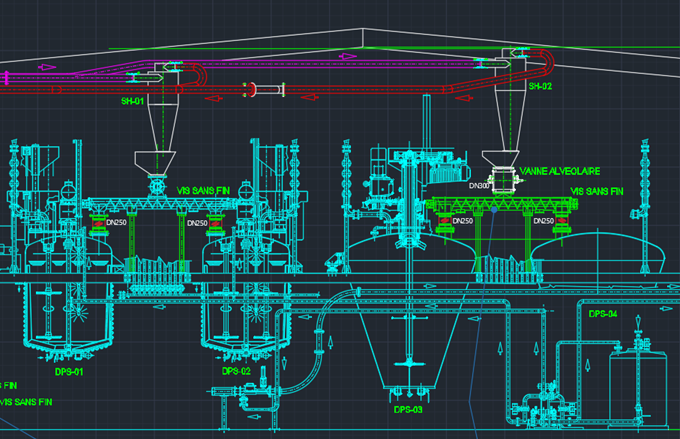
Two cyclonic hoppers (SH-01 and SH-02) were installed at the highest available elevation, making full use of the vertical space. These hoppers deliver continuous, controlled solids discharge directly onto the dispersers:
The cyclonic geometry promotes the flow of cohesive materials, minimizing bridging and caking risks while sustaining continuous, high-rate discharge in space-constrained conditions.
Closed-Loop Pneumatic Conveying (Loop System)
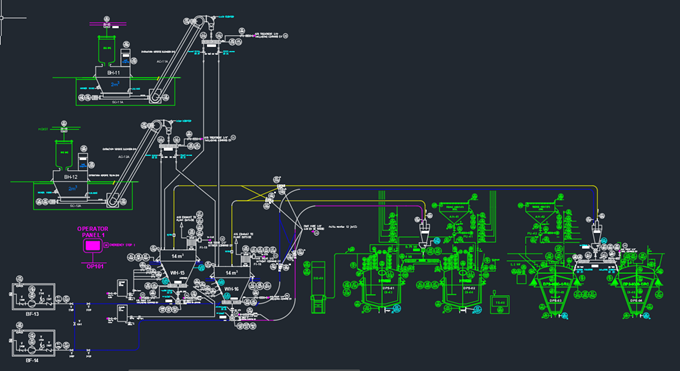
Solids transfer relies on dilute-phase pneumatic conveying in a closed-loop configuration, moving material from 14 m³ floor-level storage hoppers (WH-01 and WH-02) up to the cyclonic hoppers.
This design delivers:
- Zero dust emissions: the system is fully enclosed
- Improved safety and housekeeping conditions
- Continuous, stable feed to the dispersers
Precise Liquid Additive and Emulsion Dosing
A dedicated system was put in place to handle liquid additives and emulsions, built around 250 L weighing hoppers and automatic distribution manifolds.
This system enables:
- Precise, repeatable dosing of critical components
- Flexible feeding to both dispersers and finishing tanks
- Full integration into the process control logic
100% Automated Finishing and Packaging Lines
The installation is rounded out by a system for fully automated product finishing and conditioning:
Finishing tanks:
- 4 units of 16,000 L
- 2 units of 11,000 L
Fitted with high-precision Mettler Toledo weighing systems and CIP cleaning via rotary spray heads.
Packaging lines:
Two automatic volumetric filling lines, Flash 21, designed for precision, repeatability, and high production throughput.
Operational and Safety Improvements
In a subsequent project phase, further upgrades were introduced to boost system reliability and working conditions:
- Replacement of vibration-based systems with Airsweep technology to improve solids discharge in large-volume hoppers
- Automation of packaging line cleaning cycles using dedicated Siemens S7-1200 PLCs
- Installation of a Big-Bag handling system with a 2,000 kg hoist, improving ergonomics and reducing operational hazards
Together, these improvements eliminated the constraints of the previous system and established a robust operational foundation capable of meeting , and exceeding, the flow rate and productivity targets defined in the project.
Arc-En-Ciel Project Results: Greater Profitability and a Cleaner Plant
The implementation of the Arc-En-Ciel project has delivered a significant step forward in operational performance, particularly in terms of conveying capacity, cycle time reduction, and overall process efficiency.
Significant Increase in Conveying Flow Rates
The closed-loop pneumatic conveying system, combined with the cyclonic hoppers, has not only met but surpassed the contractual targets:
- Calcium carbonate (CaCO3): hasta 20 t/h (objetivo: 18 t/h)
- Titanium dioxide (TiO2): hasta 17 t/h (objetivo: 12 t/h)
- Talc: up to 11 t/h
These figures represent a substantial improvement over the previous system, eliminating the bottlenecks caused by poor solid-air separation that had been restricting flow rates and causing material losses.
Reduced Cycle Times and Higher Productivity
The higher feed rates have made it possible to quadruple solids feeding capacity to the dispersion stage, significantly cutting batch loading times and, by extension, total process time.
The knock-on effects are tangible:
- Higher plant throughput
- Less idle time in the dispersion stage
- Improved overall equipment effectiveness (OEE)
Better Product Containment and Working Conditions
The switch to a closed-loop conveying system has eliminated dust emissions and the material losses associated with traditional filtration-based systems.
On top of this, integrating pigging (pipe cleaning) transfer systems on the mill-base lines has made it possible to:
- Maximize product recovery
- Reduce waste
- Improve cleaning efficiency and process traceability
Expanded Parallel Operating Capacity
The system architecture — with independent conveying lines including duplicated storage hoppers, blowers, and cyclonic hoppers — enables simultaneous feeding of two dispersers, effectively doubling the plant’s operational capacity at the solids loading stage.
Technical Assessment: Eliminating Manufacturing Bottlenecks
- Elimination of the main process bottleneck (solids feeding)
- Simultaneous improvement across capacity, operational efficiency, and cleanliness
- A step change from a design-limited system to a robust, scalable solution fit for demanding production environments
Is your production plant facing space or capacity challenges?
At Oliver + Batlle, we specialize in designing bespoke process engineering projects for the paint and coatings industry. We optimize your facilities to achieve maximum efficiency and profitability.
Get in touch with our engineering team today and find out how we can help you overcome your production bottlenecks.