1. Company Overview
Founded in 1961, Pinturas Montó began its activity in Valencia producing vegetable glues and traditional tempera paints. Over the years, it evolved into the manufacture of decorative plastic paints, becoming a benchmark brand in the sector.
Since 1996, the company has operated from its 46,000 m² facility in Marines (Valencia), equipped with advanced manufacturing and quality-control technology. Montó maintains a firm commitment to innovation, sustainability and international expansion, achieving a production capacity of over 200,000 L per day with a consolidated presence in multiple countries.
2. Product to be processed
Pinturas Montó offers a complete product range for the decorative and professional markets, including:
- Interior plastic paints (matt, mid-sheen and satin).
- Exterior façade coatings (siloxanic, monocapa, SATE systems).
- Water-based enamels for multiple substrates.
- Fillers, primers and surface-preparation products.
- Tinting systems with bases, colourants and proprietary software.
- Technical coatings: damp-proof, intumescent, wood protection and sports-floor coatings.
3. Project objective
Pinturas Montó identified the need to increase its production capacity for manufacturing large batches of white water-based paint, both for its own brand and for third parties. The main objective was to achieve a continuous, stable and highly efficient production flow, optimising time, resources and operating costs.
Although the company already had process equipment, the rise in demand required a fully automated line capable of integrating:
- Manufacturing
- Filling
- Palletising
The installation also had to handle two different container ranges simultaneously:
- Small formats (up to 5 L)
- Large formats (up to 20 L)
This led to the design of a dual-line, high-output filling system, ensuring the performance, accuracy and efficiency required by Pinturas Montó.
4. Oliver + Batlle solution
Oliver + Batlle provided a comprehensive solution combining continuous production, automated filling and in-line quality control.
Production
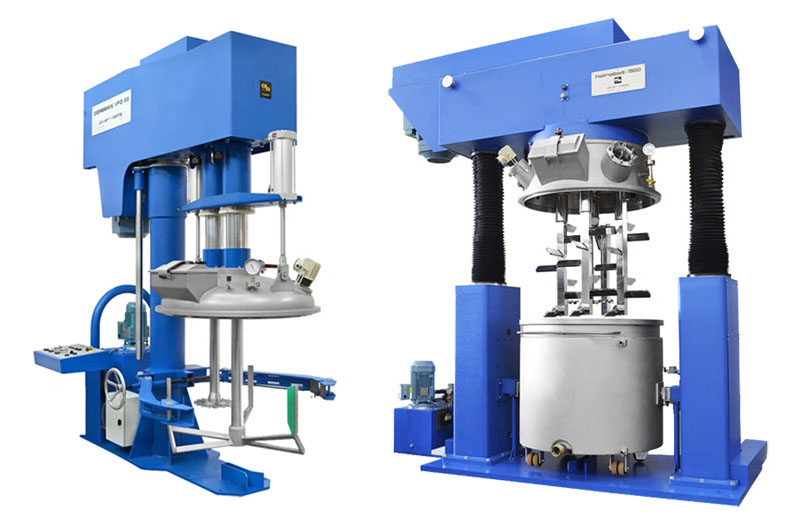
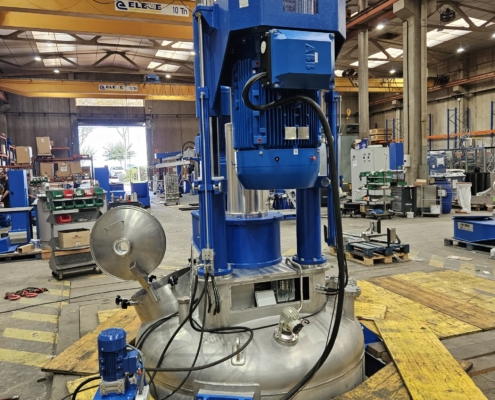
A Dispermix VF-400-E was installed together with two 20,000-L tanks positioned on the customer’s existing platform.
This setup allows:
- Manufacturing a new batch while the previous one is being filled
- Eliminating downtime
- Maintaining a constant feed to the filling lines
Automatic filling – dual line
Two automatic lines with a common structure were implemented:
Filling line for large-containers (up to 20 L)
Featuring:
- Automatic pail denester PAILMANAGER
- Automatic labelling machine
- Flash-25-T , volumetric filling machine including:
- Two dosing heads
- Two independent hoppers
- Lid dispenser and closing unit
- Checkweigher with automatic correction
- Rejecting system
The checkweigher communicates with both dosing heads, automatically adjusting volumes according to variations in the paint’s rheological behaviour.
Filling line for small-containers (up to 5 L)
Featuring:
- Semi-automatic feeding table SQ
- Automatic labelling machine
- Volumetric filling unit Flash-55-S, equipped with a single dosing head and offering similar features to the Flash-25-T , optimised for smaller formats.
5. Results
Continuous production: While one 20,000-L tank feeds the filling lines, the next batch is manufactured in the second tank, ensuring constant flow and eliminating downtime.
Reduced cleaning time: As the line works exclusively with white paint, cleaning is required only once a week, significantly reducing downtime and associated costs.
Increased productivity: Full automation and the ability to handle up to 29 different formats enable Montó to meet both internal demand and third-party production with greater flexibility and speed.