1. Company Overview

Founded in 1961, Pinturas Montó began its activity in Valencia producing vegetable glues and traditional tempera paints. Over the years, it evolved into the manufacture of decorative plastic paints, becoming a benchmark brand in the sector.

Since 1996, the company has operated from its 46,000 m² facility in Marines (Valencia), equipped with advanced manufacturing and quality-control technology. Montó maintains a firm commitment to innovation, sustainability and international expansion, achieving a production capacity of over 200,000 L per day with a consolidated presence in multiple countries.


2. Product to be processed

Pinturas Montó offers a complete product range for the decorative and professional markets, including:

  • Interior plastic paints (matt, mid-sheen and satin).
  • Exterior façade coatings (siloxanic, monocapa, SATE systems).
  • Water-based enamels for multiple substrates.
  • Fillers, primers and surface-preparation products.
  • Tinting systems with bases, colourants and proprietary software.
  • Technical coatings: damp-proof, intumescent, wood protection and sports-floor coatings.


3. Project objective

Pinturas Montó identified the need to increase its production capacity for manufacturing large batches of white water-based paint, both for its own brand and for third parties. The main objective was to achieve a continuous, stable and highly efficient production flow, optimising time, resources and operating costs.

Although the company already had process equipment, the rise in demand required a fully automated line capable of integrating:

  • Manufacturing
  • Filling
  • Palletising

The installation also had to handle two different container ranges simultaneously:

  • Small formats (up to 5 L)
  • Large formats (up to 20 L)

This led to the design of a dual-line, high-output filling system, ensuring the performance, accuracy and efficiency required by Pinturas Montó.


4. Oliver + Batlle solution

Oliver + Batlle provided a comprehensive solution combining continuous production, automated filling and in-line quality control.

Production

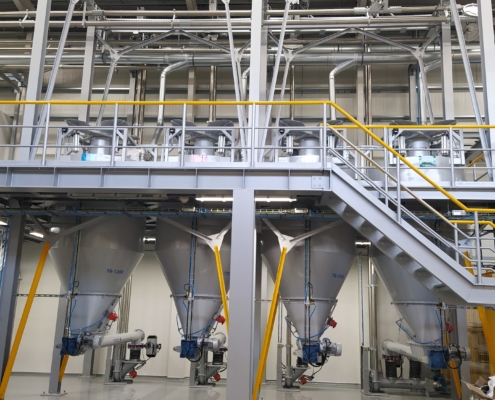
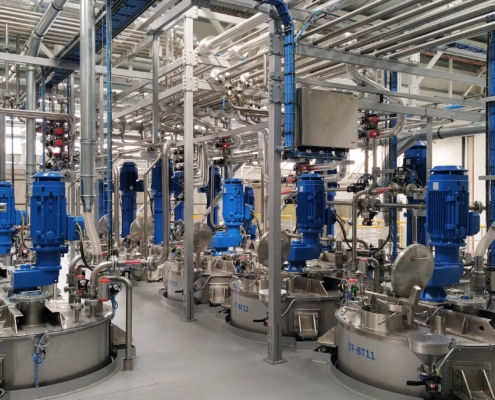
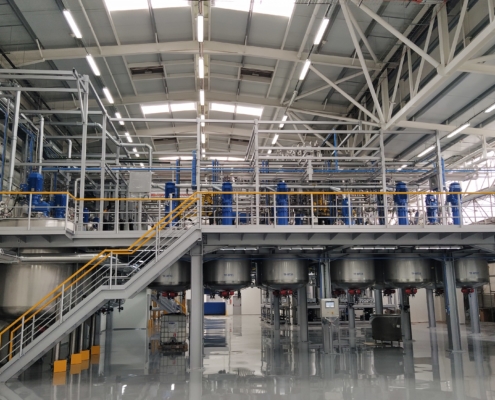
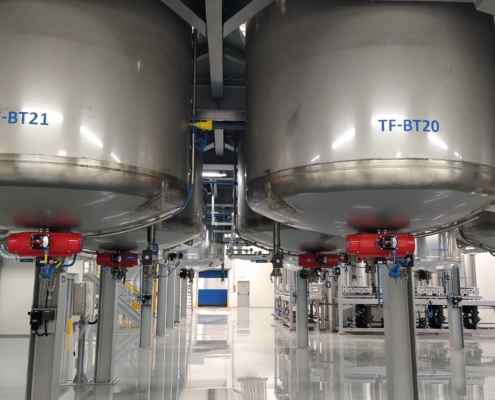
A Dispermix VF-400-E was installed together with two 20,000-L tanks positioned on the customer’s existing platform.

This setup allows:

  • Manufacturing a new batch while the previous one is being filled
  • Eliminating downtime
  • Maintaining a constant feed to the filling lines

Automatic filling – dual line

Two automatic lines with a common structure were implemented:

Filling line for large-containers (up to 20 L)

Featuring:

  • Automatic pail denester PAILMANAGER
  • Automatic labelling machine
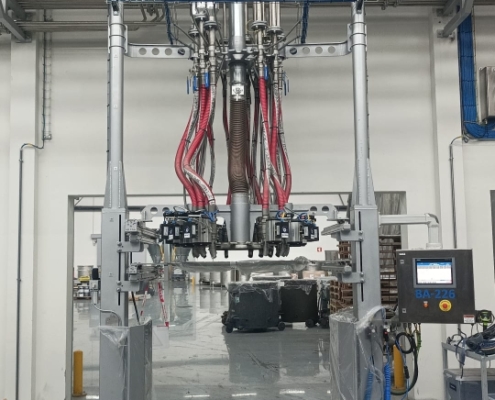
  • Flash-25-T , volumetric filling machine including:
    • Two dosing heads
    • Two independent hoppers
    • Lid dispenser and closing unit
    • Checkweigher with automatic correction
    • Rejecting system

The checkweigher communicates with both dosing heads, automatically adjusting volumes according to variations in the paint’s rheological behaviour.

Filling line for small-containers (up to 5 L)

Featuring:

  • Semi-automatic feeding table SQ
  • Automatic labelling machine
  • Volumetric filling unit Flash-55-S, equipped with a single dosing head and offering similar features to the Flash-25-T , optimised for smaller formats.


5. Results

Continuous production: While one 20,000-L tank feeds the filling lines, the next batch is manufactured in the second tank, ensuring constant flow and eliminating downtime.

Reduced cleaning time: As the line works exclusively with white paint, cleaning is required only once a week, significantly reducing downtime and associated costs.

Increased productivity: Full automation and the ability to handle up to 29 different formats enable Montó to meet both internal demand and third-party production with greater flexibility and speed.


Introduction

If your manufacturing process for paints, sealants, or putties involves a change in viscosity when stirred, you are working with thixotropy. But do you know how to measure and control this phenomenon to guarantee consistency in the container and ease of application?

Thixotropy is the fundamental rheological property by which some complex fluids drastically modify their viscosity, becoming more fluid, when a shear force (such as stirring) is applied to them. This phenomenon is key: the fluid has a high equilibrium viscosity at rest and “liquefies” during working.

Below, we will delve into the concept, explore the crucial difference with pseudoplastic fluids, and analyse how thixotropy determines the choice of the most efficient machinery in the manufacturing, finishing, and packaging phases of your products.

1. What Thixotropy is and Why it is Crucial in Viscosity

The technical concept of thixotropy involves the decrease in viscosity over time under a constant stress or shear rate, followed by a gradual recovery of the original viscosity (equilibrium viscosity) when that stress ceases.

Think of it this way: the paint in the pot is thick (high equilibrium viscosity), but when stirred or applied with a brush, it becomes fluid (low viscosity), allowing for application. Once on the wall, the shearing ceases and the product quickly recovers its initial viscosity, preventing sagging.

1.1. The Key Difference: Thixotropic vs. Pseudoplastic

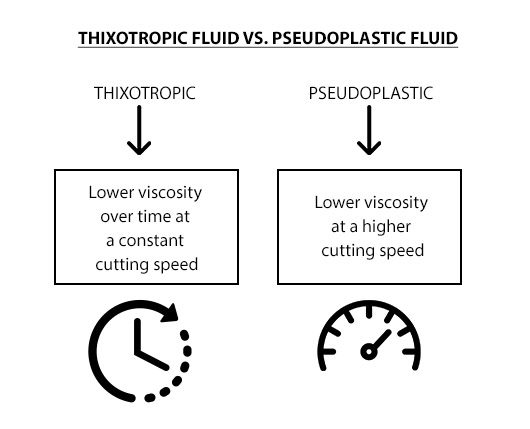
It is common for thixotropy to be confused with the behaviour of pseudoplastic fluids. Although both show a decrease in viscosity with shearing, the time difference is fundamental:

1.2. Rheopectic: The Opposite Behaviour (Anti-Thixotropy)

In contrast, fluids that exhibit the opposite behaviour to thixotropy, where constant stirring causes solidification or an increase in viscosity over time, are called rheopectic or anti-thixotropic. These products are significantly less common in the coatings industry.

thixotropy vs pseudoplastic

2. Thixotropy and Manufacturing: The Demand on Industrial Machinery

Thixotropy does not affect all formulations equally. Products such as varnishes, lacquers, and traditional synthetic and water-based paints are usually non-thixotropic. However, highly specialised products such as wood sealants, waterproofing paints, and repair putties are eminently thixotropic.

When selecting manufacturing machinery, it is imperative to know the level of thixotropy of the product. The stirring equipment must meet two key requirements to ensure homogeneity:

  1. Offer the adequate power to break the fluid’s initial thixotropy.
  2. Maintain a constant speed for the time necessary to reach the optimum working state.

2.1. Specific Equipment for High Thixotropy Products

The equipment from Oliver + Batlle is designed to manage these rheological challenges with high efficiency:

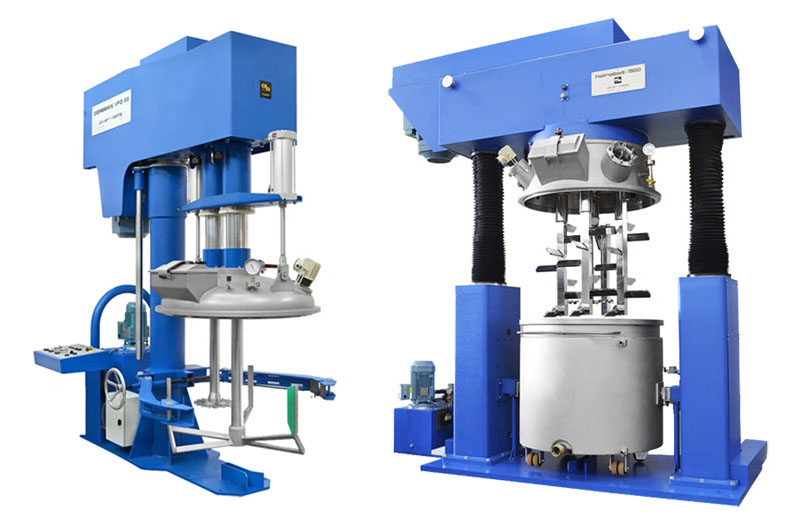
  • Dual Dispermix: Suitable for medium and high viscosity products that exhibit moderate thixotropy.
  • Hidrobat Planetary Mixer: The ideal solution for high viscosity and very thixotropic products (and also pseudoplastic ones), ensuring intensive and uniform working.

mezcladores productos tixotropicos

It is important to remember that, once manufactured and agitation has stopped, the product cools and increases its viscosity, acquiring the appropriate rest state for its final application.


3. The Thixotropic Packaging Challenge: Dosing and Pumping Solutions

The packaging of thixotropic products presents its own set of challenges, the main one being the difficulty of extracting the product from the container due to its high equilibrium viscosity.

3.1. Tank Emptying: Hydraulic Presses and Volumetric Equipment

To facilitate the emptying of portable tanks (which often reach 1,500 litres), high-force extraction equipment is required:

  • Hydraulic Press Systems (PH or PCH – TVH Press): The pressing pressure is capable of extracting medium and high thixotropic viscosity products that would otherwise be impossible to pump at rest.

Once out of the tank, the most precise measuring and dosing systems are volumetric type (such as the DVB 250), which can be easily automated with container conveying and closing systems.

3.2. Industrial Filling Machines: Gravimetric and Positive Displacement

In the Oliver + Batlle portfolio, we have specific solutions for different capacities:

  • Low Volume Filling Machines (E.g., Model EM 52): Designed for packaging highly thixotropic and high viscosity products in containers of up to 250 cc (common in offset inks or repair putties).
  • High Volume Filling Machines (E.g., DG 60 or OB 130): These gravimetric filling machines are fed by electric positive displacement screw pumps, as these better handle the high viscosity and nature of the fluid.

Process Note: To avoid suction problems in the pumps, it is vital that thixotropic products remain under agitation in the finishing tank during the packaging phase.

Conclusion: The Need for Rigorous Control

Thixotropy is a complex but essential property for the final quality of specialised coatings. Understanding the difference with pseudoplastic fluids and applying the correct stirring and extraction regime not only guarantees a homogenous product but also optimises the packaging process.

Do not risk the quality of your formulation. If you want to guarantee that your thixotropic products are manufactured and packaged with maximum efficiency and according to specifications, you need the right machinery.

Act Now! We invite you to contact the Oliver + Batlle specialists directly to request technical advice and discover which equipment (stirrers, presses, or filling machines) best suits the exact profile of your products.


Do you really know if your paint batch will meet the required specifications for finish, durability and application?
In the demanding process of coatings manufacturing, quality control is not optional—it is the guarantee of performance. Properties such as viscosity, specific weight or color must be continuously verified to ensure that the final product is not only applicable but also delivers the expected result to the customer.

In this technical guide, we will thoroughly analyze the 7 fundamental characteristics you must control in your production process. Discover the methods, units of measurement and key equipment to master paint control and take the quality of your formulation to the next level.

1. Paint Viscosity: Concept, Units and Essential Measurement

Viscosity is defined as the internal resistance of a liquid to flow or be poured. This resistance originates from the friction between the molecules of the fluid. It is essentially the opposite characteristic to fluidity: the greater the fluidity, the lower the viscosity.

The official unit of measurement in the International System (SI) is Pascal-second (Pa·s), although Poise is traditionally used. In the industry, its submultiple, the centipoise (cP), is frequently used, since water has a viscosity of 1.0020 cP at 20 °C (1 cP = 1 mPa·s).

Key Technical Note: Temperature has a dramatic influence on viscosity. Reporting the measurement temperature is mandatory; in the paint industry, it is typically measured at 25 °C.

There are three leading types of devices used to measure paint viscosity:

1.1. Efflux Cups: Ford, Zahn and Gardner (Flow Time)

These devices operate based on “flow time.” They measure the time, in seconds, it takes for a fixed volume of liquid to flow through a calibrated orifice (with different cup numbers). They are fast and easy to use, widely applied in inks and adhesives manufacturing, although they are not recommended for non-Newtonian fluids (whose viscosity varies with applied shear).

1.2. Stormer Viscometer: Measuring Viscosity in Krebs Units (KU)

The Stormer viscometer uses a standardized paddle that rotates when weight is applied. The time required to complete 100 revolutions at a given weight is measured. Results are expressed in Krebs Units (KU), using a reference chart such as ASTM D562.

1.3. Brookfield Viscometer: Rotational Viscosity Measurement (cps)

This system measures viscosity by detecting the torque required to rotate a spindle at constant speed while immersed in the fluid. The reading is given in centipoises (cps).

Attention: For correct measurement, it is crucial to take the reading at the same moment from the beginning of agitation, especially in thixotropic products, whose viscosity can vary with time under shear.

  • Pycnometer: A container with a known volume (e.g., 100 cc) with a cap that includes an overflow. It is filled, weighed with a precision balance, and its known volume allows for very accurate determination of density or specific weight.
  • Graduated cylinder: A calibrated cylinder (e.g., 100 cc) can also be used; although the procedure is similar to the pycnometer, results are less precise.

3. Thixotropy: The Phenomenon of Viscosity Reduction Under Shear

Thixotropy is a fundamental property in paints and many inks. It is the ability of some liquids or gels to decrease their viscosity when shear stress (agitation) is applied.

When the liquid is at rest, particles are randomly oriented, resulting in high viscosity. When agitated, particles align in the direction of flow, allowing them to slide past each other more easily and, therefore, reducing viscosity.

4. Grind Fineness: Dispersion Quality and Its Impact on Finish

Grind fineness is a direct indicator of the degree of dispersion of a paint; that is, the approximate maximum diameter of pigment and filler particles.

This parameter is critical because an inadequate value directly affects:

  • Final color and gloss

  • Corrosion resistance

  • Sedimentation, flocculation and floating problems

The most commonly used instruments to measure grind fineness are grind gauges (grindometers), microscopes with image analysis and laser-based systems.

5. Paint Color: Measurement, Coordinates and Spectrophotometry

Color is a subjective visual sensation, but its measurement must be objective and precise. To define color in the industry, three elements are required: the object, the illuminant and the detector.

Accurate color measurement is carried out using the CIELab system, based on a reflectance curve. This system defines:

  • L: Lightness (more or less white/dark)

  • a and b: Chromaticity (hue and saturation)

The key instrument is the reflectance spectrophotometer, which not only calculates the reflectance curve and coordinates but is essential for color matching, determining the exact amounts of colorant required.

5.1. Tinting Strength: Pigment Coloring Power

Tinting strength is the ability of a pigment or paint to color when mixed with white or another color.

It is measured using the ratio “colored pigment / white pigment” required to achieve a defined standard depth of color. The analysis is performed with the spectrophotometer on film applications of both sample and standard.

5.2. Hiding Power (Opacity): How to Cover the Substrate

Hiding power is the ability of paint to conceal the color of the surface onto which it is applied (opacity).

It depends on the type and percentage of pigment and, fundamentally, on the relationship between the refractive indices of the pigment and the medium. The greater the difference between the indices, the higher the hiding power.

It is measured through the contrast ratio (CR = Rn/Rb), which indicates how close the paint is to full coverage, by comparing reflectance over black-white contrast charts using a spectrophotometer.

6. Gloss: Specular Reflection and Measurement by Angles (Glossmeter)

Gloss or specular reflection is the ability of the paint film to reflect incoming light. The smoother the surface, the higher the gloss. This property depends mainly on the type of resin used.

Gloss is measured with a reflectometer or glossmeter at specific angles depending on the finish:

  • 20°: very glossy surfaces

  • 60°: medium gloss surfaces

  • 85°: matte or near-matte surfaces

Results are expressed as the percentage of light reflected compared to a reference standard, taken as 100.

7. Additional Controls in Paint Manufacturing and Conclusion

Mastering viscosity, color and hiding power is essential, but quality control does not end there. In liquid paint manufacturing, stability, flocculation, flexibility and skin formation must also be analyzed. In dry paint, factors such as film thickness, hardness, adhesion and washability are controlled.

The quality of your final product depends directly on the precision of your control and manufacturing equipment.

At Oliver + Batlle, we hope this technical guide will be extremely useful to you in optimizing your processes. If you are looking for mixing, dispersion or packaging solutions that ensure rigorous compliance with these characteristics, we invite you to consult our industrial machinery catalog or contact our expert team for personalized advice.

1. COMPANY OVERVIEW

Sakata INX is a Japan-based multinational company and a global leader in the development and manufacture of printing inks.

Its Spanish subsidiary, Sakata INX España, S. A., operates a production facility offering a wide range of high-quality inks for the graphic sector. These products are manufactured using advanced technologies in varnish production and pigment dispersion, ensuring excellent performance and superior print quality.

The company’s commitment to innovation and continuous improvement has led it to modernise its manufacturing processes to meet the high standards of international markets.

2. PRODUCT TO BE PROCESSED

The project focused on optimising the production of a white printing ink, specifically designed for application on plastic packaging films.

This white ink acts as an opaque background layer, playing a key role in the final visual quality by enabling a clear and uniform reproduction of colours printed on top.

Due to its high opacity requirements, the formulation contains a high concentration of titanium dioxide (TiO?) — a pigment known for its covering power, but also for its high density, cost, and difficult handling properties.

3. PROJECT OBJECTIVES

Prior to implementing the new system, the unloading and dispersion of a single Big Bag of TiO? took approximately one hour, creating bottlenecks in the production line.

The client needed to significantly reduce this time without compromising product quality or operational safety.

Oliver + Batlle was tasked with developing a solution capable of:

  • Increasing the speed of TiO? dosing and dispersion.
  • Allowing for continuous, parallel operation to avoid production downtime.
  • Improving handling safety and cleanliness.
  • Maintaining or enhancing final product quality.

4. TECHNICAL SOLUTION IMPLEMENTED BU OLIVER + BATLLE

The solution integrates a high-capacity, safe and efficient powder handling system, a high-performance conical disperser, a pneumatic transfer and filtration group, and two gravimetric filling lines adapted to multiple packaging formats.

Powder handling system

  • Tubular screw conveyor made of carbon steel, with discharge outlet feeding into the disperser.
  • Driven by a 9.2kW motor.
  • Powder handling capacity: up to 13 ?m³/h
  • Three loading points:
    • Two Big Bag inlets, enabling parallel operation (while one bag is being emptied, the next is positioned for uninterrupted feeding)
    • One manual sack inlet, providing  flexibility for smaller batches or special formulations

Dispersion systems

  • POLIMIX DPS-7500-TRC conical disperser, engineered for large-scale, high-demand production
    • Total capacity: 7,500 litres
    • Main motor: 132 kW
    • Two dispersing blades: diameters 675 mm and 450 mm
    • Half-pipe cooling jacket for temperature control
    • Vertical condenser with a 2 heat exchange surface

The disperser design ensures effective incorporation of dense pigments and a highly homogeneous mixture. Its cylindro-conical geometry optimises product flow towards the dispersing blades and improves dispersion performance.

Automatic cleaning system

  • Motorised cleaning lance with rotating head
  • 3″ pneumatic pump fitted with particle filter
  • Nominal flow rate: 150 l/min

This system allows rapid and safe cleaning between batches, reducing downtime and avoiding cross-contamination.

Transfer and filtration

  • GBN12/SBF-0102 transfer and filtration unit, pneumatically driven (2″)
  • 31-litre basket filter with 200-micron mesh, ensuring product cleanliness prior to filling

Filling lines

Two gravimetric filling lines cover a wide range of formats:

1.PALLET 1500/G

  • For 200-litre drums and IBCs
  • Equipped with a floor scale rated up to 1,500 kg

2. OB-130

  • For cans up to 30 kg
  • Includes an integrated 30 kg scale


5. RESULTS ACHIEVED

The implementation of the new solution brought a significant improvement in production performance:

  • Over 60% reduction in TiO? unloading and dispersion time
  • Continuous operation enabled by dual Big Bag inlets, eliminating handling delays
  • Increased powder flow rate, outperforming the previous system
  • Higher productivity and process consistency, without compromising product quality
  • Improved safety and cleanliness, through a closed and automated solution

In summary, the collaboration between Sakata Ink España and Oliver + Batlle has resulted in a robust, high-capacity and efficient installation tailored to the demanding needs of white ink production.

It is a flexible, high-performance solution that ensures top-quality standards in one of the most critical areas of the printing ink manufacturing process.


A high-precision project in the heart of the cosmetics industry

COBELSA Cosméticos S.A., located in Alcalá de Henares (Spain), is part of the L’ORÉAL Group and specializes in the production of nail polish for international brands such as Maybelline and Color Riche. All production is destined for markets in Europe, Brazil, and the United States.

As part of its continuous improvement strategy, COBELSA turned to Oliver + Batlle to develop a new manufacturing unit for bentone gel, a key ingredient in nail polish formulas, acting as a rheological agent that ensures the suspension and stability of pigments and resins.

The challenge: safety, precision and automation in a confined ATEX zone

The project came with several critical technical challenges:

  • Extremely limited installation space
  • Location in a classified ATEX II GD zone, due to the presence of solvent vapors and bentonite dust
  • Vacuum powder feeding of explosive bentonite into a flammable medium (butyl acetate + nitrocellulose)
  • Manufacturing process requiring a permanently inert atmosphere (O? < 6%) to prevent premature drying
  • A fully automated and traceable control system

O+B was tasked with delivering a compact, safe and high-performance solution tailored to these conditions.

O+B’s solution: compact engineering in a skid-mounted system

O+B’s technical team designed a complete and autonomous skid, optimized for integration into the ATEX environment and adapted to the space constraints of the plant, consisting of:

Working platform

1. POLIMIX DPS-1200-OR Disperser

  • ATEX Zone 0 certified (internal)
  • Weighing system via load cells
  • Half-coil cooling jacket, product temperature probe and minimum level sensor
  • CIP cleaning system with automatic motorized lance
  • Liquid input via multi-way feed collector

2. Bentonite powder hopper

  • Stainless steel AISI 304, capacity 150 L
  • Vacuum suction lance for 25 kg bags
  • Vacuum monitoring via manovacuum gauge
  • Percussion hammer for complete discharge

3. Vacuum powder feeding system

  • Flameproof filter above the disperser
  • Flame arrestor + modulated vacuum valve
  • Side channel vacuum blower
  • Acid dispersion input by vacuum

4. ATEX safety & inert gas control

  • Grounding verification system for all components


  • Nitrogen inerting system (N2)

  • Oxygen monitoring sensors in both disperser and powder hopper

5. Fully automated control system

  • ATEX-rated HMI touchscreen in classified area
  • SCADA system in a safe zone with integrated recipe manager


Results: enhanced quality and safe, controlled production

The solution developed by O+B enabled COBELSA to:

  •  Comply with the most demanding ATEX safety standards
  •  Eliminate manual handling of explosive powders
  •  Maintain a stable inert atmosphere (O? < 6%) during the process
  •  Achieve higher gel quality compared to previous systems
  •  Fully automate and digitize the gel manufacturing process

This project demonstrates how modular engineering and technical expertise allow O+B to overcome complex challenges in sensitive environments. With this solution, O+B strengthens its position as a trusted technology partner in the cosmetic industry, where process control, product consistency, and safety are non-negotiable.


accessories for the automation