Manufacturing of paints and inks using DISPERVAC
Introduction
Oliver & Batlle began using vacuum loading systems in complex industrial applications many years ago. The experience gained with difficult-to-handle powdered products such as Aerosil, carbon black, glass microspheres and bentonite prompted O+B to develop an R&D project focused on creating a specific solution for this application: the vacuum loading system for powdered raw materials, called DISPERVAC.
DISPERVAC solves the problem of loading raw materials that are difficult to handle due to their volatility, dirtiness, contaminating characteristics or health risks.
Several chemical industry machinery manufacturers have been introducing inline mixing systems to the market for years for the incorporation of powdered raw materials into dispersion processes. With the aim of offering a robust and competitive alternative, Oliver & Batlle developed the DISPERVAC system, which combines vacuum feeding of solids with the Polimix dispersion system, achieving a highly efficient, safe, and versatile solution. After analysing the various processes available on the market, we believe our DISPERVAC technology is also particularly interesting for incorporating pigments such as titanium dioxide (TiO?), which is widely used in the paint industry for its hiding power and colorimetric performance but is difficult to handle and expensive.
In the next article, we will present some ideas that will support the promotion and use of the DISPERVAC system, which we hope will be of interest to you.
Advantages of vacuum loading of powdered products with the DISPERVAC system in paint and ink manufacturing
Nowadays, pigment cost is one of the most significant factors in the manufacturing of paints and inks. Reducing pigment usage can represent a considerable cost savings and improve overall process profitability.
One of the most widely used pigments is titanium dioxide (TiO?) a costly and difficult-to-handle material. Depending on the formulation, it can suppose for 25% to 40% of the total production cost. There has long been ongoing discussion around the possibility of classifying TiO? as a carcinogenic substance, which could eventually lead to regulations restricting its use.
In anticipation of such a scenario, Oliver + Batlle has developed a vacuum powder loading system compatible with dispersion machines, designed to streamline the handling of powdered pigments and facilitate their safe and efficient incorporation into the production process.
Vacuum loading of powdered pigments in paint and ink manufacturing offers major advantages, especially for dispersing pigments such as TiO?:
- Enhances the colorimetric strength of the pigments.
- Allows for reduced pigment usage, as air-free dispersions ensure better particle distribution and more efficient processing, avoiding the “airbag effect” caused by excess air.
DISPERVAC: An ultra-efficient vacuum dispersion method
The DISPERVAC system consists of two main units:
- A powder handling and transfer system, equipped with vacuum technology.
- A production unit based on coaxial conical dispersion technology, specifically designed to operate under vacuum conditions.
The vacuum handling system is particularly suitable for highly volatile or fine powders, such as aluminum silicates or glass microspheres, as well as for various pigments and fillers like TiO?, calcium carbonate, talc, or silica. Oliver + Batlle offers the system in two configurations:
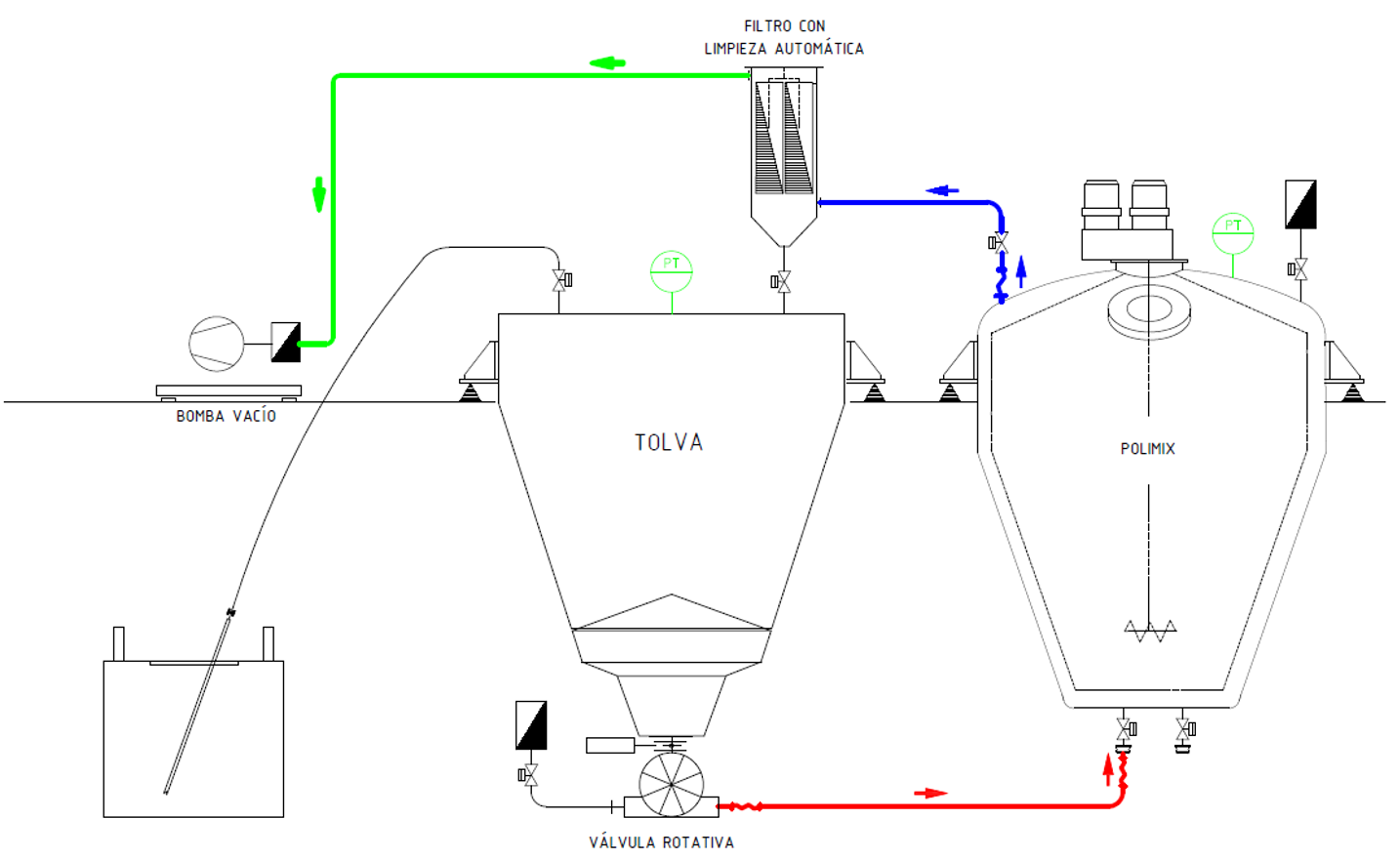
- With a sealed vessel where the full powder formula can be prepared, as shown in the diagram:
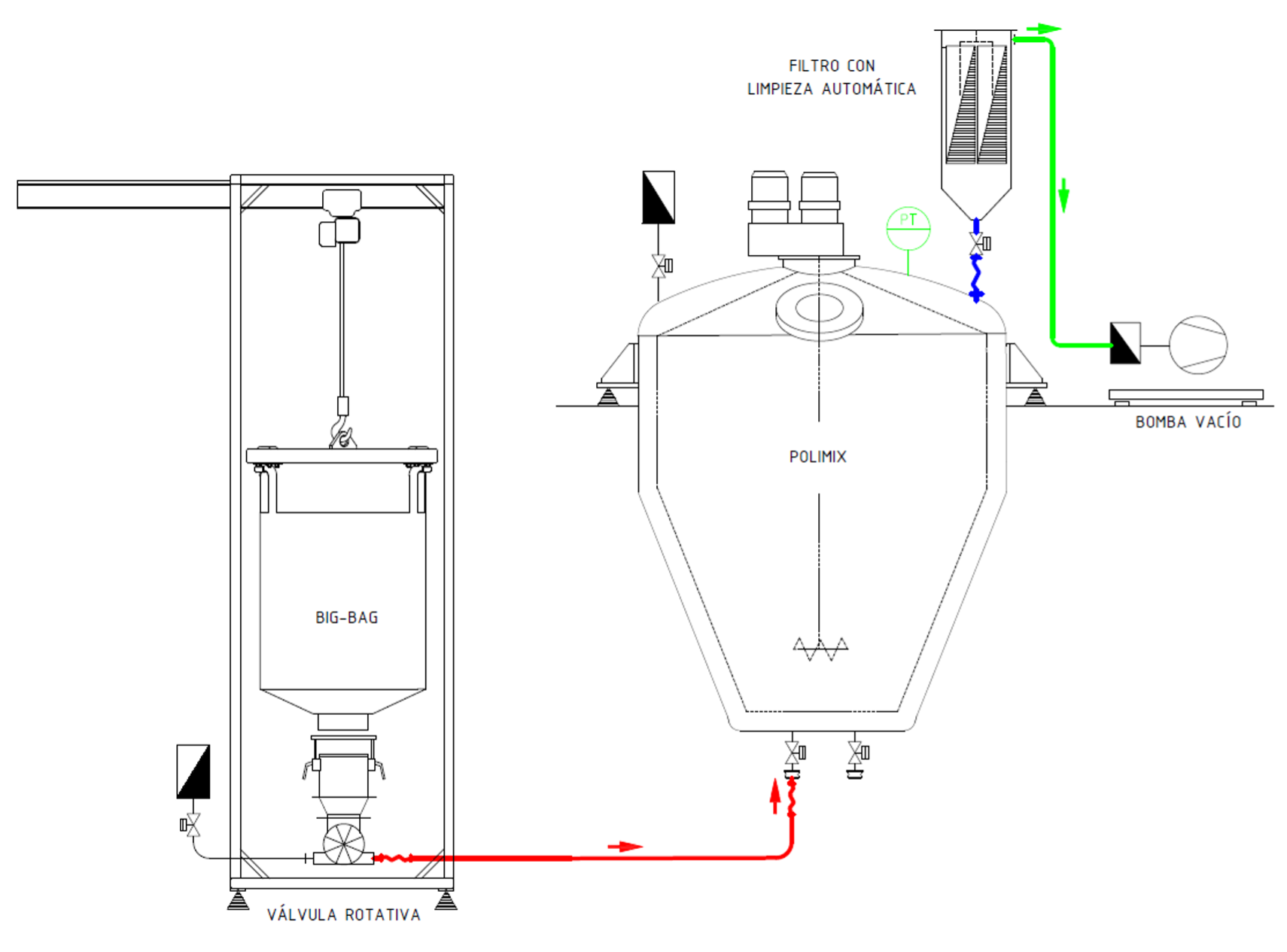
- With solutions adapted to powders supplied in big bags or standard 25 kg sacks.
In the first case, the preload hopper can be used to prepare the powder mix before transferring it to the manufacturing unit.
The vacuum system is used for two main operations:
- Powder raw material loading
- Air extraction from the finished product
DISPERVAC can be fully parameterized for each product, allowing a wide range of powders to be handled regardless of their bulk density or particle size.
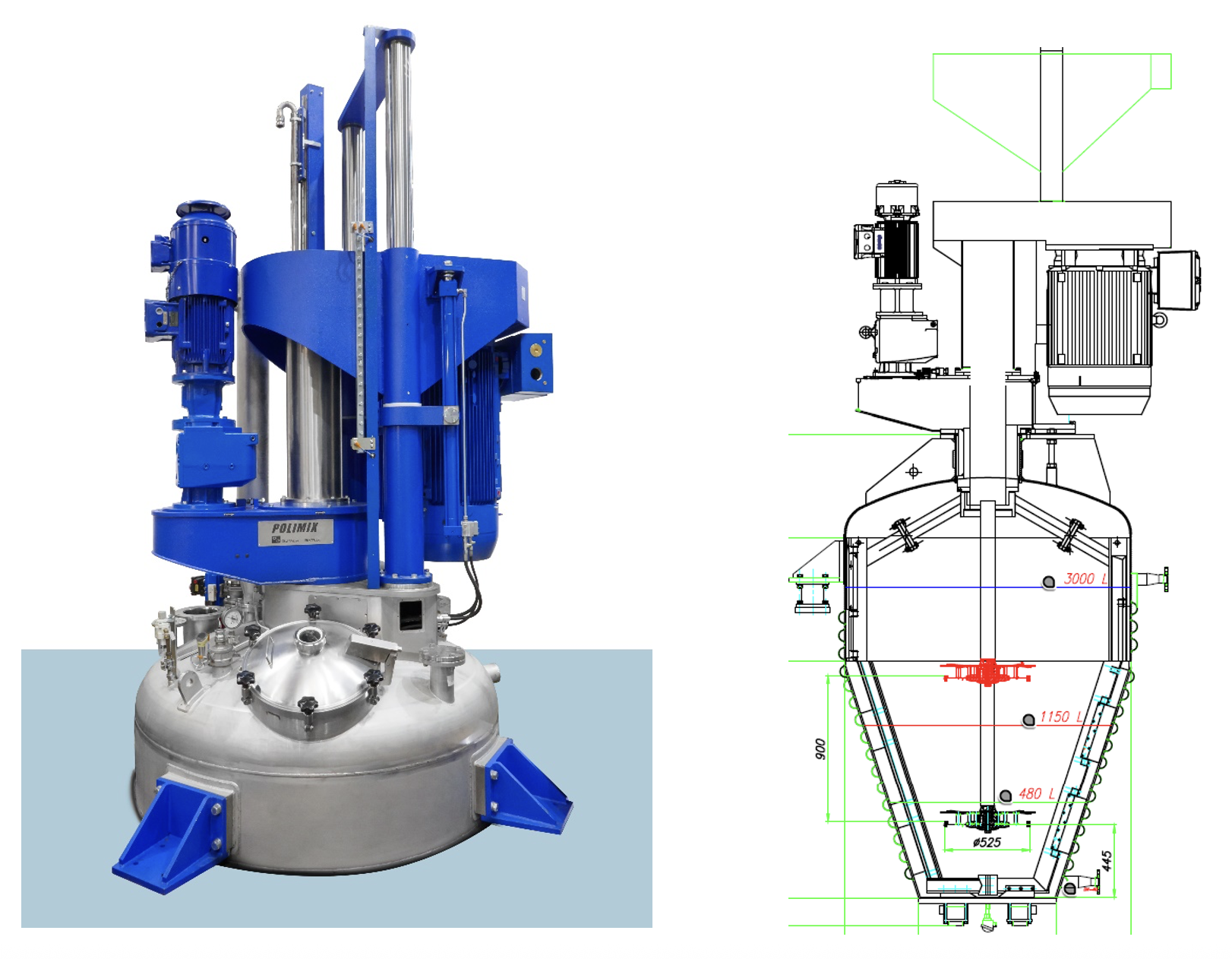
The production unit must be airtight and designed for vacuum operation. For maximum dispersion efficiency, we recommend using a Polimix vessel of conical trunk form equipped with two coaxial agitation systems:
- A dispersing unit with one or two turbines featuring lift/lower mechanisms.
- An anchor-type homogenizer with flexible wall scrapers to ensure optimal mixing.
These machines are highly efficient in dispersion processes, since vacuum loading takes place from the bottom of the vessel, enabling immediate incorporation of pigments into the liquid flow generated by the dispersion turbine. This avoids pigment floating or surface accumulation, which is common in top-loading systems.
The conical shape conduces the powders directly into the primary turbine, allowing the process to begin with a minimal amount of liquid. When using an appropriate dispersant—in both type and quality—excellent dispersion results are achieved.
The DISPERVAC system allows the handling of powdered products by vacuum, completely avoiding dust emissions during loading and associated material losses. It is particularly suitable for low-density products or those requiring special handling conditions due to health hazards for plant operators—such as TiO?.
The vacuum suction system can be fully programmed, allowing pigments to be introduced into the formulation at a controlled and repeatable feed rate.
The adition of pigments in paint and ink manufacturing is a critical and sometimes complex operation. With the programmable DISPERVAC system, a precise and repeatable process is guaranteed, enabling the optimal incorporation of pigments free from entrapped air. This air-free dispersion improves pigment performance, increases color strength, and reduces raw material costs in formulations.
What kind of manufacturing equipment is used in a DISPERVAC installation?
Using dispersers equipped with saw-tooth turbines or HDM-type turbines, as traditionally done, remains an effective method—especially when operating with tanks whose geometry enhances turbine efficiency, such as trunk conical shapes.
This geometry allows the dispersion phase to begin with minimal liquid volume, increasing the effectiveness of the turbines. In large-capacity machines, a small turbine can be placed at the bottom and a second, larger one in an intermediate position. Even when both turbines operate simultaneously, the required installed power does not need to be high.
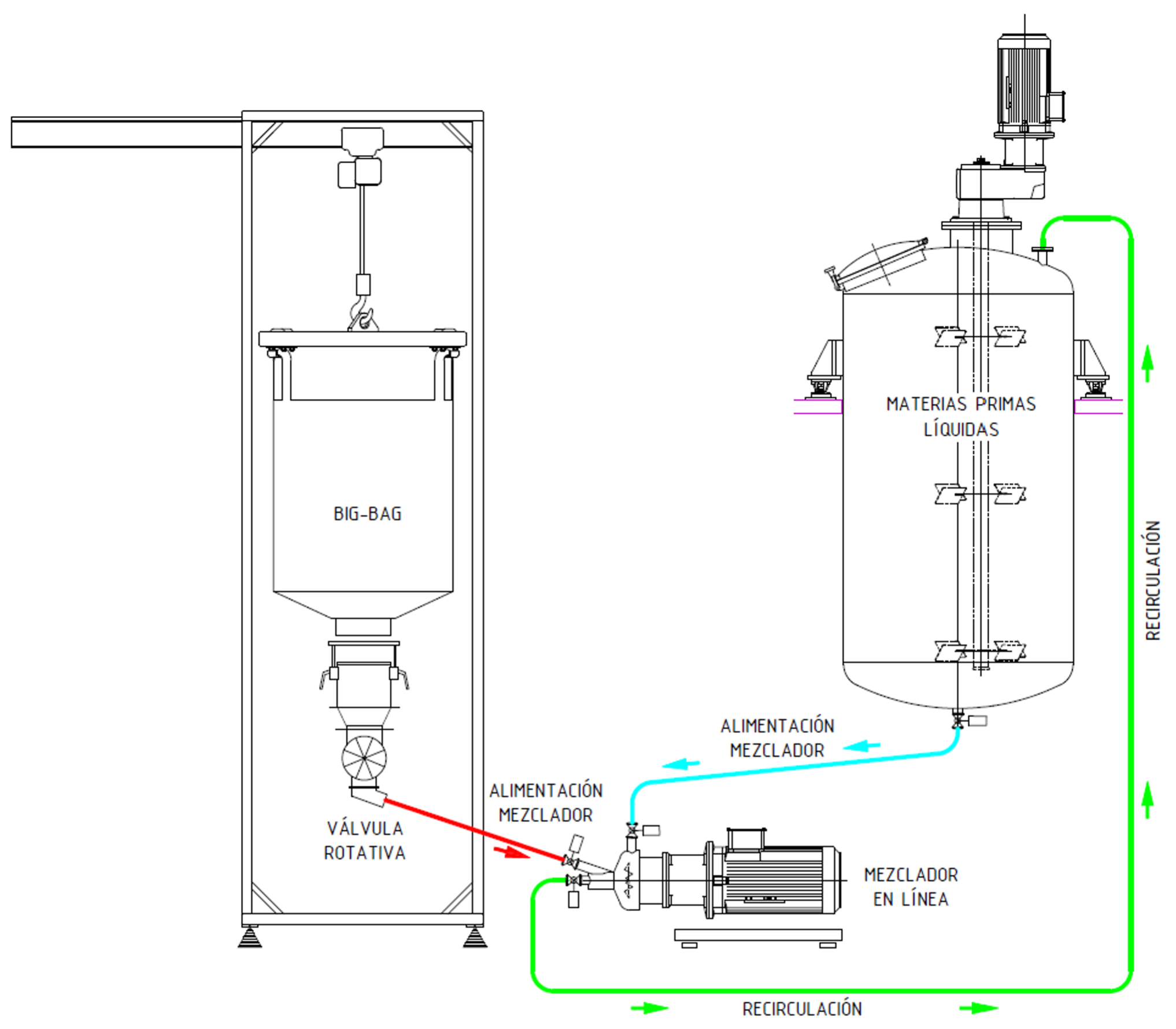
Comparing the DISPERVAC system with inline mixing processes
Inline vacuum dispersion systems promoted in the market often claim the advantage of lower installed power. However, this argument must be linked to the speed of the dispersion process.
To achieve faster dispersion times than a traditional disperser—and to ensure sufficient suction capacity for powdered pigments—inline mixers must operate at very high speeds, which in turn requires high power consumption (according to available technical data, some machines reach up to 110?kW).
Additionally, inline mixers require a recirculation and homogenization tank, which also needs to be equipped with an agitator. The required power for this agitator depends on the batch volume. In total, the combined power requirement of an inline system often exceeds that of a Polimix coaxial trunk conical disperser.
Another often-overlooked challenge in inline dispersion systems is the temperature rise within the dispersion chamber. This can be particularly problematic for solvent-based formulations containing volatile or flammable components.
Moreover, air removal from powder-based raw materials during the inline dispersion process is only possible if a dedicated vacuum system is installed—something that is frequently not included in standard configurations.
Air removal during the DISPERVAC manufacturing process
Many pigments used in the production of paints and inks contain entrapped air, which can account for 25% to 30% of their volume. When vacuum loading is applied, a small amount of air is introduced to help transport the powder into the disperser.
Additionally, saw-tooth turbine dispersers tend to incorporate small amounts of air during the shearing process. While the presence of air at certain points during pigment dispersion can aid in wetting the pigment particle surfaces, it can become problematic later in the process.
Excess air at the end of production may lead to volume instability or air bubbles appearing during application. With the DISPERVAC system, these issues are eliminated, as the same vacuum system used for loading can also extract residual air from the final product.
An air-free production process ensures a more uniform particle distribution and prevents foaming or bubble formation during paint or ink application. In printing inks, the removal of air enhances gloss and visual performance.
Foam caused by air entrapment in conventional dispersion processes is often corrected by adding defoamers. However, manufacturing with DISPERVAC allows for vacuum-based air extraction, significantly reducing—or even eliminating—the need for antifoaming agents and consequently lowering formulation costs.
Pigment and filler incorporation with the DISPERVAC system
In a traditional water-based decorative paint manufacturing process using cylindrical tanks, the dispersion of TiO? usually starts with the maximum amount of liquid possible to create a large enough volume for powder incorporation.
In contrast, the DISPERVAC installation, which uses trunk conical-shaped dispersers, allows for a different strategy: taking advantage of the conical bottom to work with the minimum required liquid volume, enabling TiO? to be dispersed more efficiently, achieving better particle size distribution and higher color development.
In a second phase, more liquid is added, followed by the fillers. This two-step sequence, with varying amounts of wetting liquid, optimizes the tinting strength of TiO?.
This sequence can be easily executed using the DISPERVAC control system, allowing for fully programmable stages. By dispersing TiO? first, improved final product quality and reduced TiO? consumption are achieved.
Manufacturing of TiO? slurries and intermediate products
The DISPERVAC system is effective for producing high-quality slurries. The programmable vacuum powder charging system ensures optimal product quality and excellent traceability throughout the manufacturing process.
The continuous slurry manufacturing system can be replaced by a DISPERVAC process using high-capacity dispersing equipment, enabling the production of up to 24 tons of slurry per single formulation. Smaller batches can also be produced with the same guaranteed quality.
Summary of advantages of vacuum pigment charging with the DISPERVAC system:
- Increases the colour strength of pigments.
- Allows reduction in the amount of pigment used in manufacturing.
- Enables complete extraction of manufacturing air before packaging.
- Reduces manufacturing cycle times.
- Reduce the amount of defoamer required in the formulation.
- Permits programmed charging of pigments and dispersants through the control system.
- Final batches have manufacturing traceability and uniform quality guaranteed by the charging control system.
Conclusion: DISPERVAC, a breakthrough in dispersion and vacuum charging processes
In summary, the DISPERVAC system represents an innovative and efficient solution for the handling and dispersion of powdered raw materials in paint and ink manufacturing. Its vacuum charging technology not only enhances process safety and ergonomics but also optimizes the technical and economic performance of formulations, especially in the handling of critical pigments such as titanium dioxide.
The combination of controlled feeding reduced entrapped air, and the ability to parameterize each operation enables superior final product quality, with greater consistency, lower cost, and improved sustainability. Oliver + Batlle thus reaffirms its commitment to innovation and excellence in industrial processes by delivering solutions that address the current challenges of the sector.