In the paints and coatings industry, efficiency is not just a goal; it is a competitive necessity. However, many production lines are still held back by conventional dosing technologies that create bottlenecks, product waste, and high maintenance costs.

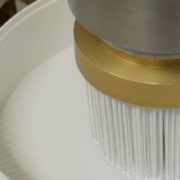
At Oliver + Batlle we have launched a 3D additive manufacturing nozzle service that does not just sell a product, but optimises your entire packaging process.

Why switch from traditional metal nozzles to 3D technology?

Additive manufacturing allows us to design “layer by layer”, breaking the limitations of traditional machining and offering tangible benefits in three critical areas:

1. Increased productivity and profitability

  • Manufacturing speed: Our nozzles allow for up to a 20% increase in filling speed compared to conventional dosers.
  • Time optimisation: Reducing the seconds per dosing cycle is the most direct way to increase your daily output.
  • Cost reduction: Improved efficiency, together with annual contract options including 10% discounts, significantly reduces the total cost of ownership.


2. Packaging quality: Zero drips, zero foam

One of the biggest challenges in paint packaging is difficult products that generate foam or residual dripping.

  • Precision design: Each nozzle is custom-designed for the specific rheology of your product.
  • A diameter for every container: We apply the principle of an optimal nozzle according to the container diameter, ensuring a millimetre-perfect fit and an impeccable finish.


3. Technical superiority of the material

Unlike heavy metal parts, our 3D nozzles offer:

  • Minimum weight: Reduces mechanical stress and wear on the dosing arms of your machines.
  • Greater impact resistance: Manufactured with high-durability technical polymers that withstand the pace of an industrial plant.
  • Ad-hoc flexibility: The process begins with a preliminary study and the development of a functional prototype to ensure the solution is perfect before final production.


A service model designed for your business

We understand that production varies, which is why our model is fully flexible. We offer a service with no long-term commitment which includes:

  • Personalised study and design.
  • Scheduled deliveries to guarantee your stock.
  • Express service: Deliveries within 24 hours in Europe and 72 hours in the rest of the world for urgent situations.


Conclusion

The digitalisation of dosing is here to stay. With Oliver + Batlle’s 3D nozzles, your company not only gains speed, but also a packaging quality that your customers will notice from the very first tin.

Are you ready to transform your production line? To discover the potential savings and see our rates (with nozzles starting from €180), contact our sales team today.

Introduction

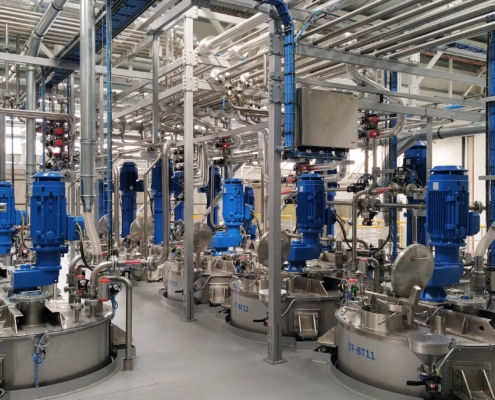
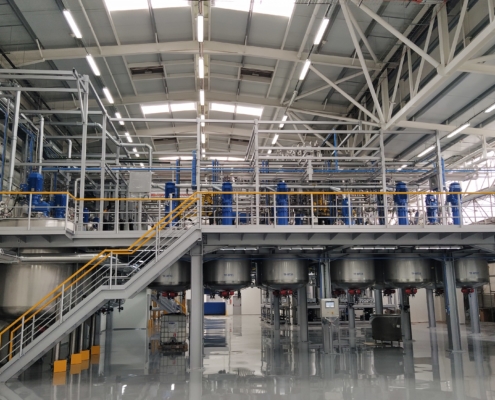
A leading company in the industrial paints and coatings sector undertook a strategic project aimed at optimising its manufacturing and filling processes for solvent-based industrial paint. The objective was to implement a highly automated installation capable of handling complex formulations, multiple raw materials, and different batch sizes, whilst maintaining the highest standards of quality, safety, traceability, and environmental responsibility.

Oliver + Batlle participated in the development and implementation of the technological solutions required to meet these objectives, contributing its expertise in dosing systems, manufacturing processes, and process control for the paints industry.

Product to be processed

The project focused on the manufacturing and filling of solvent-based industrial paint, intended for the protection and decoration of surfaces, with high requirements in terms of homogeneity, repeatability, and final product performance.

Project objectives

The company sought a solution that would enable the manufacturing and filling of a wide variety of products, in different batch sizes, through fully automated and highly controlled processes.

The main technical challenges of the project were:

  • Management of a large number of raw materials, with more than 60 different products, including solids and liquids, many of them transferred via piping.
  • Ensuring the required quality for each formulation, regardless of its complexity.
  • Guaranteeing full traceability of raw materials and process operations.
  • Maintaining optimal safety and hygiene conditions, with a design focused on zero pollution, for both solids and liquids, despite working with solvent-based products.
  • Fully automating the production process through recipe execution from the control system.

Solutions provided by Oliver + Batlle

Oliver + Batlle developed and integrated a set of process and automation solutions, specifically designed to meet the requirements of a leading manufacturer in the sector.

Solid dosing and conveying

For the handling of solid raw materials, the following solutions were implemented:

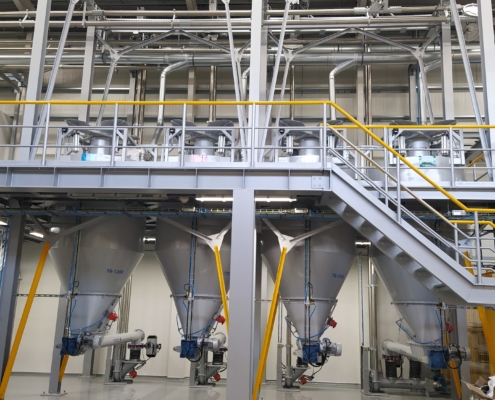
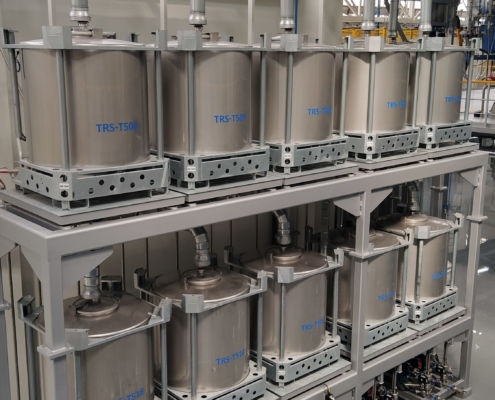
  • Installation of four 6 m³ mini-silos for powder raw materials, with automatic transfer through a pneumatic conveying system running throughout the plant to the different consumption points.
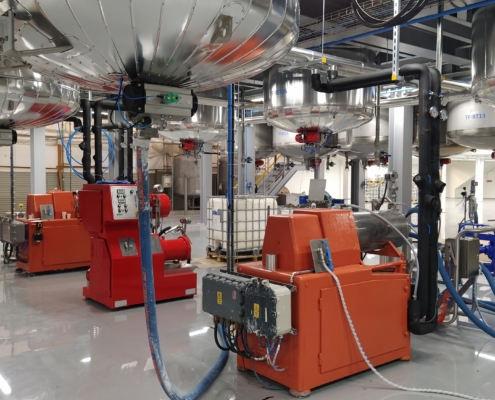
  • Dosing station for solids not stored in silos, supplied from bags or big-bags, with direct pneumatic conveying to the dispersers used for large-batch production.
  • Mechanical conveying system with a capacity of up to 6 t/h, designed to automatically feed and dose solids to four dispersers located on the process platform.

Liquid dosing

The solution incorporates an automatic liquid dosing system, integrated into recipe management, enabling precise dosing of:

  • Major raw materials, such as resins and solvents.
  • A large number of additives, managed according to defined formulations.

Manufacturing and finishing processes

The Mill Base is manufactured in single-shaft and three-shaft dispersers, from which the product is transferred to intermediate tanks through milling processes.

The milled products are then transferred to finishing tanks of different capacities, equipped with mixing systems specifically designed according to the type of product and its rheological requirements.

Small-batch production

The solution combines large-batch manufacturing with short-run production through:

  • Four automatic dosing stations, capable of managing multiple different products per recipe.
  • Dosing heads with horizontal movement, facilitating manual dosing from drums.
  • A set of 19 process units, including dispersers, mixers, and milling systems, dedicated to small-batch production.

Automation and traceability

The entire installation is governed by a fully automatic control system, with recipe management and communication with the customer’s ERP, enabling centralised control of all manufacturing operations.

In addition, a barcode creation and reading system was integrated for manually added products, ensuring complete traceability of raw materials and the production process.

Results

The implemented solutions allow this leading company to operate a highly flexible, safe, and efficient industrial paint manufacturing and filling system, capable of handling a wide variety of formulations and batch sizes.

Key benefits achieved:

  • High production flexibility, adapted to a broad product portfolio.
  • Full automation, ensuring accuracy, repeatability, and process control.
  • Maximum safety and hygiene, with a plant designed to operate under zero-pollution conditions.
  • Strong environmental commitment, even in processes involving solvent-based products.

Our technical team can help you define the most suitable solution for your process


1. Company Overview

Founded in 1961, Pinturas Montó began its activity in Valencia producing vegetable glues and traditional tempera paints. Over the years, it evolved into the manufacture of decorative plastic paints, becoming a benchmark brand in the sector.

Since 1996, the company has operated from its 46,000 m² facility in Marines (Valencia), equipped with advanced manufacturing and quality-control technology. Montó maintains a firm commitment to innovation, sustainability and international expansion, achieving a production capacity of over 200,000 L per day with a consolidated presence in multiple countries.


2. Product to be processed

Pinturas Montó offers a complete product range for the decorative and professional markets, including:

  • Interior plastic paints (matt, mid-sheen and satin).
  • Exterior façade coatings (siloxanic, monocapa, SATE systems).
  • Water-based enamels for multiple substrates.
  • Fillers, primers and surface-preparation products.
  • Tinting systems with bases, colourants and proprietary software.
  • Technical coatings: damp-proof, intumescent, wood protection and sports-floor coatings.


3. Project objective

Pinturas Montó identified the need to increase its production capacity for manufacturing large batches of white water-based paint, both for its own brand and for third parties. The main objective was to achieve a continuous, stable and highly efficient production flow, optimising time, resources and operating costs.

Although the company already had process equipment, the rise in demand required a fully automated line capable of integrating:

  • Manufacturing
  • Filling
  • Palletising

The installation also had to handle two different container ranges simultaneously:

  • Small formats (up to 5 L)
  • Large formats (up to 20 L)

This led to the design of a dual-line, high-output filling system, ensuring the performance, accuracy and efficiency required by Pinturas Montó.


4. Oliver + Batlle solution

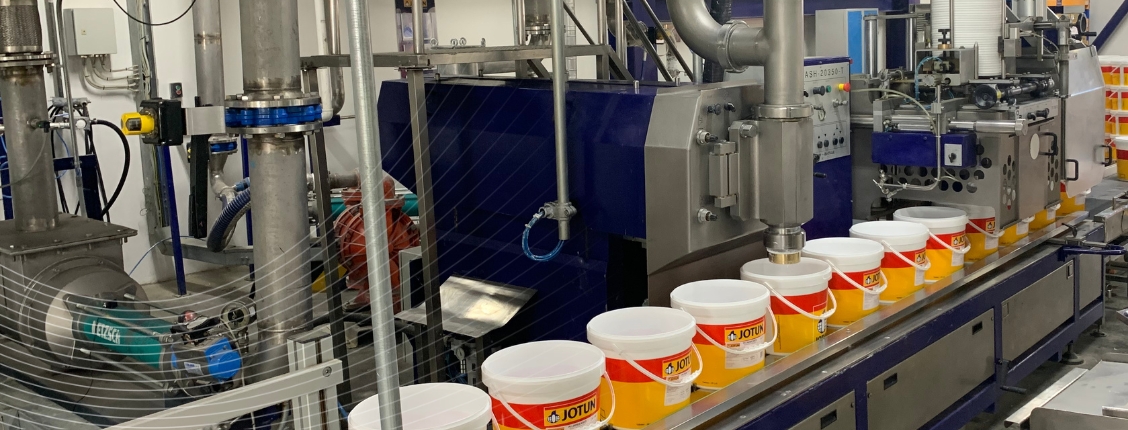
Oliver + Batlle provided a comprehensive solution combining continuous production, automated filling and in-line quality control.

Production

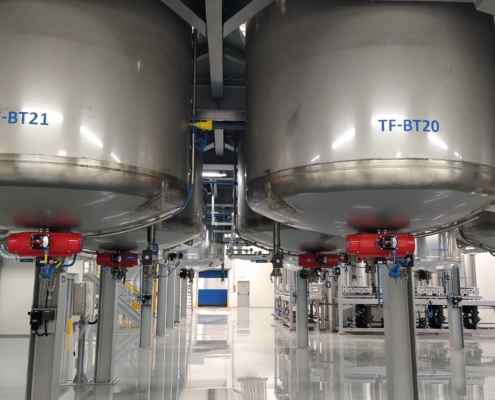
A Dispermix VF-400-E was installed together with two 20,000-L tanks positioned on the customer’s existing platform.

This setup allows:

  • Manufacturing a new batch while the previous one is being filled
  • Eliminating downtime
  • Maintaining a constant feed to the filling lines

Automatic filling – dual line

Two automatic lines with a common structure were implemented:

Filling line for large-containers (up to 20 L)

Featuring:

  • Automatic pail denester PAILMANAGER
  • Automatic labelling machine
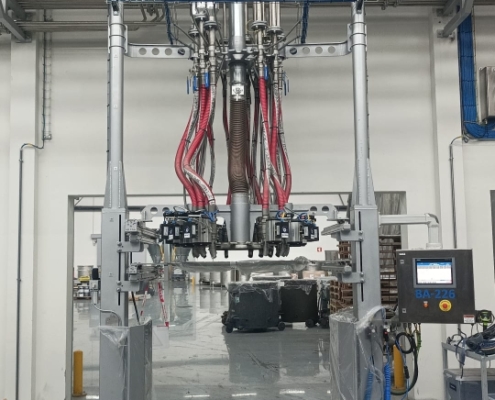
  • Flash-25-T , volumetric filling machine including:
    • Two dosing heads
    • Two independent hoppers
    • Lid dispenser and closing unit
    • Checkweigher with automatic correction
    • Rejecting system

The checkweigher communicates with both dosing heads, automatically adjusting volumes according to variations in the paint’s rheological behaviour.

Filling line for small-containers (up to 5 L)

Featuring:

  • Semi-automatic feeding table SQ
  • Automatic labelling machine
  • Volumetric filling unit Flash-55-S, equipped with a single dosing head and offering similar features to the Flash-25-T , optimised for smaller formats.


5. Results

Continuous production: While one 20,000-L tank feeds the filling lines, the next batch is manufactured in the second tank, ensuring constant flow and eliminating downtime.

Reduced cleaning time: As the line works exclusively with white paint, cleaning is required only once a week, significantly reducing downtime and associated costs.

Increased productivity: Full automation and the ability to handle up to 29 different formats enable Montó to meet both internal demand and third-party production with greater flexibility and speed.


Introduction

If your manufacturing process for paints, sealants, or putties involves a change in viscosity when stirred, you are working with thixotropy. But do you know how to measure and control this phenomenon to guarantee consistency in the container and ease of application?

Thixotropy is the fundamental rheological property by which some complex fluids drastically modify their viscosity, becoming more fluid, when a shear force (such as stirring) is applied to them. This phenomenon is key: the fluid has a high equilibrium viscosity at rest and “liquefies” during working.

Below, we will delve into the concept, explore the crucial difference with pseudoplastic fluids, and analyse how thixotropy determines the choice of the most efficient machinery in the manufacturing, finishing, and packaging phases of your products.

1. What Thixotropy is and Why it is Crucial in Viscosity

The technical concept of thixotropy involves the decrease in viscosity over time under a constant stress or shear rate, followed by a gradual recovery of the original viscosity (equilibrium viscosity) when that stress ceases.

Think of it this way: the paint in the pot is thick (high equilibrium viscosity), but when stirred or applied with a brush, it becomes fluid (low viscosity), allowing for application. Once on the wall, the shearing ceases and the product quickly recovers its initial viscosity, preventing sagging.

1.1. The Key Difference: Thixotropic vs. Pseudoplastic

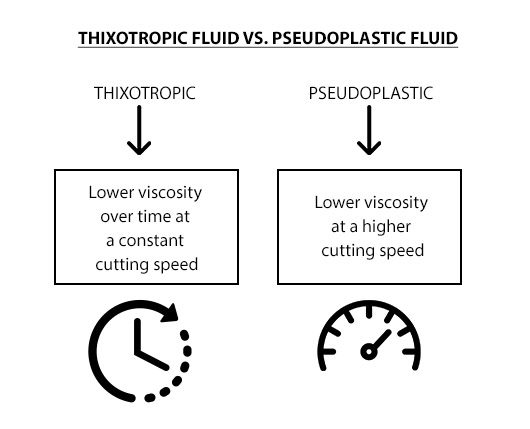
It is common for thixotropy to be confused with the behaviour of pseudoplastic fluids. Although both show a decrease in viscosity with shearing, the time difference is fundamental:

1.2. Rheopectic: The Opposite Behaviour (Anti-Thixotropy)

In contrast, fluids that exhibit the opposite behaviour to thixotropy, where constant stirring causes solidification or an increase in viscosity over time, are called rheopectic or anti-thixotropic. These products are significantly less common in the coatings industry.

thixotropy vs pseudoplastic

2. Thixotropy and Manufacturing: The Demand on Industrial Machinery

Thixotropy does not affect all formulations equally. Products such as varnishes, lacquers, and traditional synthetic and water-based paints are usually non-thixotropic. However, highly specialised products such as wood sealants, waterproofing paints, and repair putties are eminently thixotropic.

When selecting manufacturing machinery, it is imperative to know the level of thixotropy of the product. The stirring equipment must meet two key requirements to ensure homogeneity:

  1. Offer the adequate power to break the fluid’s initial thixotropy.
  2. Maintain a constant speed for the time necessary to reach the optimum working state.

2.1. Specific Equipment for High Thixotropy Products

The equipment from Oliver + Batlle is designed to manage these rheological challenges with high efficiency:

  • Dual Dispermix: Suitable for medium and high viscosity products that exhibit moderate thixotropy.
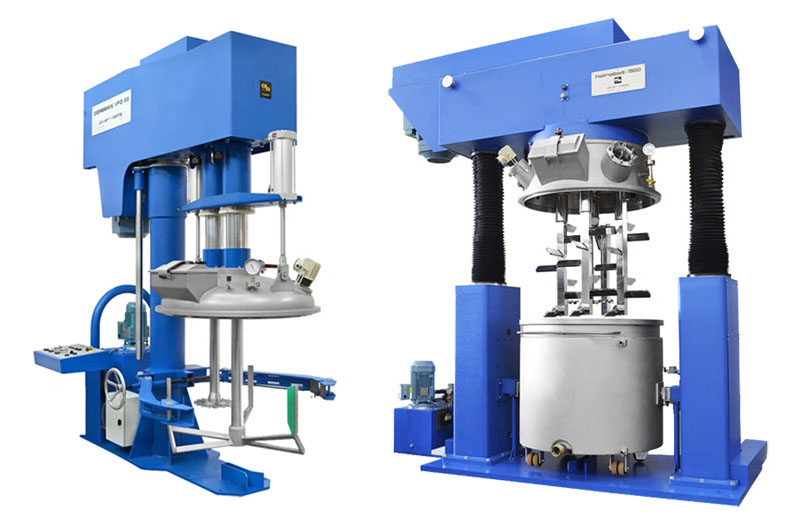
  • Hidrobat Planetary Mixer: The ideal solution for high viscosity and very thixotropic products (and also pseudoplastic ones), ensuring intensive and uniform working.

mezcladores productos tixotropicos

It is important to remember that, once manufactured and agitation has stopped, the product cools and increases its viscosity, acquiring the appropriate rest state for its final application.


3. The Thixotropic Packaging Challenge: Dosing and Pumping Solutions

The packaging of thixotropic products presents its own set of challenges, the main one being the difficulty of extracting the product from the container due to its high equilibrium viscosity.

3.1. Tank Emptying: Hydraulic Presses and Volumetric Equipment

To facilitate the emptying of portable tanks (which often reach 1,500 litres), high-force extraction equipment is required:

  • Hydraulic Press Systems (PH or PCH – TVH Press): The pressing pressure is capable of extracting medium and high thixotropic viscosity products that would otherwise be impossible to pump at rest.

Once out of the tank, the most precise measuring and dosing systems are volumetric type (such as the DVB 250), which can be easily automated with container conveying and closing systems.

3.2. Industrial Filling Machines: Gravimetric and Positive Displacement

In the Oliver + Batlle portfolio, we have specific solutions for different capacities:

  • Low Volume Filling Machines (E.g., Model EM 52): Designed for packaging highly thixotropic and high viscosity products in containers of up to 250 cc (common in offset inks or repair putties).
  • High Volume Filling Machines (E.g., DG 60 or OB 130): These gravimetric filling machines are fed by electric positive displacement screw pumps, as these better handle the high viscosity and nature of the fluid.

Process Note: To avoid suction problems in the pumps, it is vital that thixotropic products remain under agitation in the finishing tank during the packaging phase.

Conclusion: The Need for Rigorous Control

Thixotropy is a complex but essential property for the final quality of specialised coatings. Understanding the difference with pseudoplastic fluids and applying the correct stirring and extraction regime not only guarantees a homogenous product but also optimises the packaging process.

Do not risk the quality of your formulation. If you want to guarantee that your thixotropic products are manufactured and packaged with maximum efficiency and according to specifications, you need the right machinery.

Act Now! We invite you to contact the Oliver + Batlle specialists directly to request technical advice and discover which equipment (stirrers, presses, or filling machines) best suits the exact profile of your products.


Do you really know if your paint batch will meet the required specifications for finish, durability and application?
In the demanding process of coatings manufacturing, quality control is not optional—it is the guarantee of performance. Properties such as viscosity, specific weight or color must be continuously verified to ensure that the final product is not only applicable but also delivers the expected result to the customer.

In this technical guide, we will thoroughly analyze the 7 fundamental characteristics you must control in your production process. Discover the methods, units of measurement and key equipment to master paint control and take the quality of your formulation to the next level.

1. Paint Viscosity: Concept, Units and Essential Measurement

Viscosity is defined as the internal resistance of a liquid to flow or be poured. This resistance originates from the friction between the molecules of the fluid. It is essentially the opposite characteristic to fluidity: the greater the fluidity, the lower the viscosity.

The official unit of measurement in the International System (SI) is Pascal-second (Pa·s), although Poise is traditionally used. In the industry, its submultiple, the centipoise (cP), is frequently used, since water has a viscosity of 1.0020 cP at 20 °C (1 cP = 1 mPa·s).

Key Technical Note: Temperature has a dramatic influence on viscosity. Reporting the measurement temperature is mandatory; in the paint industry, it is typically measured at 25 °C.

There are three leading types of devices used to measure paint viscosity:

1.1. Efflux Cups: Ford, Zahn and Gardner (Flow Time)

These devices operate based on “flow time.” They measure the time, in seconds, it takes for a fixed volume of liquid to flow through a calibrated orifice (with different cup numbers). They are fast and easy to use, widely applied in inks and adhesives manufacturing, although they are not recommended for non-Newtonian fluids (whose viscosity varies with applied shear).

1.2. Stormer Viscometer: Measuring Viscosity in Krebs Units (KU)

The Stormer viscometer uses a standardized paddle that rotates when weight is applied. The time required to complete 100 revolutions at a given weight is measured. Results are expressed in Krebs Units (KU), using a reference chart such as ASTM D562.

1.3. Brookfield Viscometer: Rotational Viscosity Measurement (cps)

This system measures viscosity by detecting the torque required to rotate a spindle at constant speed while immersed in the fluid. The reading is given in centipoises (cps).

Attention: For correct measurement, it is crucial to take the reading at the same moment from the beginning of agitation, especially in thixotropic products, whose viscosity can vary with time under shear.

  • Pycnometer: A container with a known volume (e.g., 100 cc) with a cap that includes an overflow. It is filled, weighed with a precision balance, and its known volume allows for very accurate determination of density or specific weight.
  • Graduated cylinder: A calibrated cylinder (e.g., 100 cc) can also be used; although the procedure is similar to the pycnometer, results are less precise.

3. Thixotropy: The Phenomenon of Viscosity Reduction Under Shear

Thixotropy is a fundamental property in paints and many inks. It is the ability of some liquids or gels to decrease their viscosity when shear stress (agitation) is applied.

When the liquid is at rest, particles are randomly oriented, resulting in high viscosity. When agitated, particles align in the direction of flow, allowing them to slide past each other more easily and, therefore, reducing viscosity.

4. Grind Fineness: Dispersion Quality and Its Impact on Finish

Grind fineness is a direct indicator of the degree of dispersion of a paint; that is, the approximate maximum diameter of pigment and filler particles.

This parameter is critical because an inadequate value directly affects:

  • Final color and gloss

  • Corrosion resistance

  • Sedimentation, flocculation and floating problems

The most commonly used instruments to measure grind fineness are grind gauges (grindometers), microscopes with image analysis and laser-based systems.

5. Paint Color: Measurement, Coordinates and Spectrophotometry

Color is a subjective visual sensation, but its measurement must be objective and precise. To define color in the industry, three elements are required: the object, the illuminant and the detector.

Accurate color measurement is carried out using the CIELab system, based on a reflectance curve. This system defines:

  • L: Lightness (more or less white/dark)

  • a and b: Chromaticity (hue and saturation)

The key instrument is the reflectance spectrophotometer, which not only calculates the reflectance curve and coordinates but is essential for color matching, determining the exact amounts of colorant required.

5.1. Tinting Strength: Pigment Coloring Power

Tinting strength is the ability of a pigment or paint to color when mixed with white or another color.

It is measured using the ratio “colored pigment / white pigment” required to achieve a defined standard depth of color. The analysis is performed with the spectrophotometer on film applications of both sample and standard.

5.2. Hiding Power (Opacity): How to Cover the Substrate

Hiding power is the ability of paint to conceal the color of the surface onto which it is applied (opacity).

It depends on the type and percentage of pigment and, fundamentally, on the relationship between the refractive indices of the pigment and the medium. The greater the difference between the indices, the higher the hiding power.

It is measured through the contrast ratio (CR = Rn/Rb), which indicates how close the paint is to full coverage, by comparing reflectance over black-white contrast charts using a spectrophotometer.

6. Gloss: Specular Reflection and Measurement by Angles (Glossmeter)

Gloss or specular reflection is the ability of the paint film to reflect incoming light. The smoother the surface, the higher the gloss. This property depends mainly on the type of resin used.

Gloss is measured with a reflectometer or glossmeter at specific angles depending on the finish:

  • 20°: very glossy surfaces

  • 60°: medium gloss surfaces

  • 85°: matte or near-matte surfaces

Results are expressed as the percentage of light reflected compared to a reference standard, taken as 100.

7. Additional Controls in Paint Manufacturing and Conclusion

Mastering viscosity, color and hiding power is essential, but quality control does not end there. In liquid paint manufacturing, stability, flocculation, flexibility and skin formation must also be analyzed. In dry paint, factors such as film thickness, hardness, adhesion and washability are controlled.

The quality of your final product depends directly on the precision of your control and manufacturing equipment.

At Oliver + Batlle, we hope this technical guide will be extremely useful to you in optimizing your processes. If you are looking for mixing, dispersion or packaging solutions that ensure rigorous compliance with these characteristics, we invite you to consult our industrial machinery catalog or contact our expert team for personalized advice.