
Thixotropy: The Definitive Guide to Paint Manufacturing
Introduction
If your manufacturing process for paints, sealants, or putties involves a change in viscosity when stirred, you are working with thixotropy. But do you know how to measure and control this phenomenon to guarantee consistency in the container and ease of application?
Thixotropy is the fundamental rheological property by which some complex fluids drastically modify their viscosity, becoming more fluid, when a shear force (such as stirring) is applied to them. This phenomenon is key: the fluid has a high equilibrium viscosity at rest and “liquefies” during working.
Below, we will delve into the concept, explore the crucial difference with pseudoplastic fluids, and analyse how thixotropy determines the choice of the most efficient machinery in the manufacturing, finishing, and packaging phases of your products.
1. What Thixotropy is and Why it is Crucial in Viscosity
The technical concept of thixotropy involves the decrease in viscosity over time under a constant stress or shear rate, followed by a gradual recovery of the original viscosity (equilibrium viscosity) when that stress ceases.
Think of it this way: the paint in the pot is thick (high equilibrium viscosity), but when stirred or applied with a brush, it becomes fluid (low viscosity), allowing for application. Once on the wall, the shearing ceases and the product quickly recovers its initial viscosity, preventing sagging.
1.1. The Key Difference: Thixotropic vs. Pseudoplastic
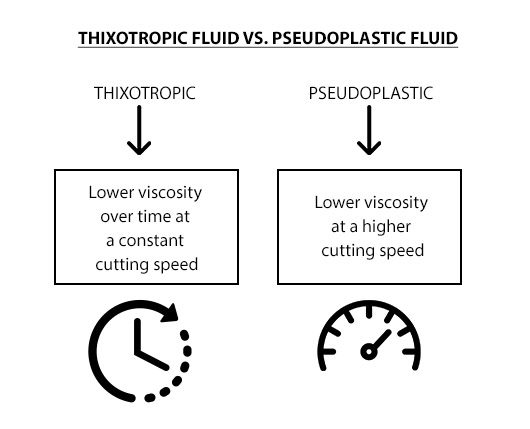
It is common for thixotropy to be confused with the behaviour of pseudoplastic fluids. Although both show a decrease in viscosity with shearing, the time difference is fundamental:
1.2. Rheopectic: The Opposite Behaviour (Anti-Thixotropy)
In contrast, fluids that exhibit the opposite behaviour to thixotropy, where constant stirring causes solidification or an increase in viscosity over time, are called rheopectic or anti-thixotropic. These products are significantly less common in the coatings industry.
2. Thixotropy and Manufacturing: The Demand on Industrial Machinery
Thixotropy does not affect all formulations equally. Products such as varnishes, lacquers, and traditional synthetic and water-based paints are usually non-thixotropic. However, highly specialised products such as wood sealants, waterproofing paints, and repair putties are eminently thixotropic.
When selecting manufacturing machinery, it is imperative to know the level of thixotropy of the product. The stirring equipment must meet two key requirements to ensure homogeneity:
- Offer the adequate power to break the fluid’s initial thixotropy.
- Maintain a constant speed for the time necessary to reach the optimum working state.
2.1. Specific Equipment for High Thixotropy Products
The equipment from Oliver + Batlle is designed to manage these rheological challenges with high efficiency:
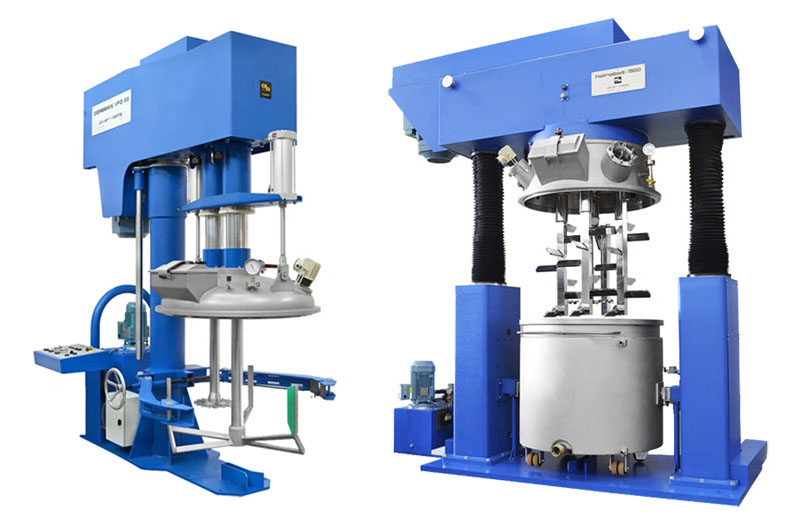
- Dual Dispermix: Suitable for medium and high viscosity products that exhibit moderate thixotropy.
- Hidrobat Planetary Mixer: The ideal solution for high viscosity and very thixotropic products (and also pseudoplastic ones), ensuring intensive and uniform working.
It is important to remember that, once manufactured and agitation has stopped, the product cools and increases its viscosity, acquiring the appropriate rest state for its final application.
3. The Thixotropic Packaging Challenge: Dosing and Pumping Solutions
The packaging of thixotropic products presents its own set of challenges, the main one being the difficulty of extracting the product from the container due to its high equilibrium viscosity.
3.1. Tank Emptying: Hydraulic Presses and Volumetric Equipment
To facilitate the emptying of portable tanks (which often reach 1,500 litres), high-force extraction equipment is required:
- Hydraulic Press Systems (PH or PCH – TVH Press): The pressing pressure is capable of extracting medium and high thixotropic viscosity products that would otherwise be impossible to pump at rest.
Once out of the tank, the most precise measuring and dosing systems are volumetric type (such as the DVB 250), which can be easily automated with container conveying and closing systems.
3.2. Industrial Filling Machines: Gravimetric and Positive Displacement
In the Oliver + Batlle portfolio, we have specific solutions for different capacities:
- Low Volume Filling Machines (E.g., Model EM 52): Designed for packaging highly thixotropic and high viscosity products in containers of up to 250 cc (common in offset inks or repair putties).
- High Volume Filling Machines (E.g., DG 60 or OB 130): These gravimetric filling machines are fed by electric positive displacement screw pumps, as these better handle the high viscosity and nature of the fluid.
Process Note: To avoid suction problems in the pumps, it is vital that thixotropic products remain under agitation in the finishing tank during the packaging phase.
Conclusion: The Need for Rigorous Control
Thixotropy is a complex but essential property for the final quality of specialised coatings. Understanding the difference with pseudoplastic fluids and applying the correct stirring and extraction regime not only guarantees a homogenous product but also optimises the packaging process.
Do not risk the quality of your formulation. If you want to guarantee that your thixotropic products are manufactured and packaged with maximum efficiency and according to specifications, you need the right machinery.
Act Now! We invite you to contact the Oliver + Batlle specialists directly to request technical advice and discover which equipment (stirrers, presses, or filling machines) best suits the exact profile of your products.