
Easy installation in plants for manufacturing decorative paints, industrial coatings, marine paints, glues, varnishes, adhesives, inks, etc.
At Oliver + Batlle, we offer a wide range of industrial agitators for mixing all
types of paints and varnishes, glues and adhesives, coatings, colorants, inks,
and mastics.
We have mixing and dispersion equipment for manufacturing
products of low, medium, and high viscosity, at laboratory and industrial
scale.
Mixing and Dispersion Equipment for Medium or Low Viscosity
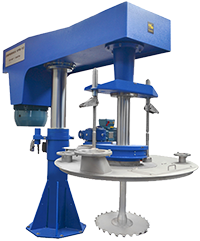

Mixing and Dispersion Equipment for High Viscosity
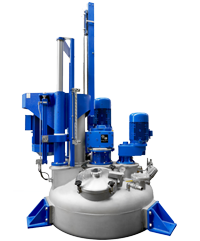
Industrial mixing machines
The industrial dispersers of Oliver + Batlle are designed for mixing paints and other types of liquids of different density , guaranteeing homogeneity and viscosity according to customer needs. Our machines stand out for their robustness and reliability in design.
Oliver + Batlle mixing equipment are mainly used in the manufacture of decorative paints, varnishes, industrial coatings, glues, adhesives or liquid inks among others.
POLIMIX
DISPERMIX
Among industrial mixers for medium or low viscosity paint, Dispermix models are the most notable in their varieties VF for portable vessels, VF-E to be mounted on platform and Polimix DPS-OR. As for high viscosity agitation machines, we highlight the Dispermix Dual VFD, Polimix DPS and planetery mixers Hidrobat. We also produce finishing tanks for mixing and finishing of paints and coatings.
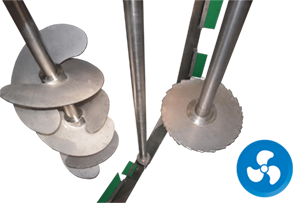
Components of industrial dissolvers
At Oliver + Batlle we are always alert to the needs and trends of the market and we apply our knowledge, experience and innovative technologies to the implementation of solutions for agitation, mixing and dispersion of paints and other products.
This state-of-the-art expertise allows us to manufacture industrial agitator machines that ensure a homogeneous finish, enhancing the mixing between the different particles that make up each product.
Advantages of Oliver + Batlle mixing solutions
Our agitator machines have a large number of advantages depending on the model and the purpose for which it has been designed. However, the following advantages are common to all of them: